
Almost all the literature in the first 150 years or so focused on what could be called the Character Ethic as the foundation of success – things like integrity, humility, fidelity, temperance, courage, justice, patience, industry, simplicity, modesty, and the Golden Rule.
Character Ethics taught that there are basic principles of effective living and that people can only experience true success and enduring happiness as they learn and integrate these principles into their basic character.

Inside-Out
But shortly after World War I the basic view of success shifted from the Character Ethic to what we might call the Personality Ethic. Success became more a function of personality, public image, attitudes and behaviors, skills and techniques, that empower the processes of human interaction. This Personality Ethic essentially took two paths: one was human and public relations techniques, and the other was a positive and mental attitude (PMA). Some of this philosophy was expressed in inspiring and sometimes valid maxims such as “Your attitude determines your altitude,” “Smiling wins more friends than frowning,” and “Whatever the mind of man can conceive and believe can achieve.”
Other parts of the personality approach were clearly manipulative, even deceptive, encouraging people to use techniques to get other people to like them, or to fake interest in the hobbies of others to get out of them what they wanted, or to use the “power look”, or to intimidate their way through life.
The Principle-Centered Paradigm
The Character Ethic is based on the fundamental idea that there are principles that govern human effectiveness – natural laws in the human dimension that are just as real, just as unchanging, and unarguably “there” as laws such as gravity are in the physical dimension.
An idea of the reality – and the impact – of these principles can be captured in another paradigm-shifting experience as told by Frank Koch in Proceedings, the magazine of the Naval Institute is captured below.
Two battleships assigned to the training squadron had been at sea on maneuvers in heavy weather for several days. I was serving on the lead battleship and was on watch on the bridge as night fell. The visibility was poor with patchy fog, so the captain remained on the bridge keeping an eye on all activities.
Shortly after dark, the lookout on the wing of the bridge reported, “Light, bearing on the starboard bow.”
“Is it steady or moving astern?” the captain called out.
Lookout replied, “Steady captain,” which meant we were on a dangerous collision course with that ship.
The captain then called to the signalman, “Signal that ship: We are on a collision course, advise you change course 20 degrees.”
Back came a signal, “Advisable for you to change course 20 degrees”
“I’m a seaman second class,” came the reply. “You had better change course 20 degrees.”
By that time, the captain was furious. He spat out, “Send I’m a battleship. Change course 20 degrees.”
Back came the flashlight light, “I’m a lighthouse.”
We change course.
The paradigm shift experienced by the captain – and by us as we read this sample – puts the situation in a totally different light. We can see a reality that is superseded by his limited perception – a reality that is as critical for us to understand in our daily lives as it was for the captain in the fog.
Principles are like lighthouses. They are natural laws that cannot be broken.
Principles of Growth and Change
The glitter of the Personality Ethic, the massive appeal, is that there is some quick and easy way to achieve a quality of life – personal effectiveness and rich, deep relationships with other people – without going through the natural process of work and growth that makes it possible.
It’s a symbol without substance. It’s the “get rich quick” scheme promising “wealth without work”. And it might even appear to succeed – but the schemer remains.
The Personality Ethic is illusory and deceptive. And trying to get high-quality results with its techniques and quick fixes is just about as effective as trying to get to someplace in Chicago using a map of Detroit.
When relationships are strained and the air is charged with emotion, an attempt to teach is often perceived as a form of judgment and rejection.
The way we see the problem is the problem
The Personality Ethic tells us there must be something out there – some new planner or seminar that will help us handle all these pressures more efficiently.
But is there a chance that efficiency is not the answer? Is getting more things done in less time going to make a difference – or will it just increase the pace at which I react to the people and circumstances that seem to control my life?
Could there be something I need to see in a deeper, more fundamental way – some paradigm within myself that affects the way I see my time, my life, and my own nature?
A new level of thinking
Albert Einstein observed, “The significant problems we face cannot be solved at the same level of thinking we were when we created them.”
This new level of thinking is what The 7 Habits of Highly Effective People is about. It’s a principle-centered, character-based, “inside-out” approach to personal and interpersonal effectiveness.
“Inside-out” means to start first with self; even more fundamentally, to start with the most inside part of self – with your paradigms, your character, and your motives.
The 7 Habits – An Overview
We are what we repeatedly do. Excellence, then, is not an act, but a habit.
Our character, basically is a composite of our habits. Habits are powerful factors in our lives. Because they are consistent, often unconscious patterns, they constantly, daily express our character and produce our effectiveness … or ineffectiveness.
“Habits” defined
For our purposes, we will define a habit as the intersection of knowledge, skill, and desire.
Happiness can be defined, in part at least, as the fruit of the desire and ability to sacrifice what we want now for what we want eventually.

The Maturity Continuum
On the maturity continuum, dependence is the paradigm of you – you take care of me; you come through for me; you didn’t come through; I blame you for the results.
Independence is the paradigm of I – I can do it; I am responsible; I am self-reliant; I can choose.
Interdependence is the paradigm of we – we can do it; we can cooperate; we can combine our talents and abilities and create something greater together.

Effectiveness defined
The 7 Habits are habits of effectiveness. Because they are based on principles, they bring the maximum long-term beneficial results possible. They become the basis of a person’s character, creating an empowering center of correct maps from which an individual can effectively solve problems, maximize opportunities, and continually learn and integrate other principles in an upward spiral of growth.
They are also habits of effectiveness because they are based on a paradigm of effectiveness that is in harmony with natural law, a principle called the “P/PC Balance”, which many people break themselves against.
If you adopt a pattern of life that focuses on golden eggs and neglects the goose, you will soon be without the asset that produces golden eggs. On the other hand, if you only take care of the goose with no aim toward the golden eggs, you soon won’t have the wherewithal to feed yourself or the goose.
Effectiveness lies in the balance – called P/PC balance.
P stands for the production of desired results, the golden eggs.
PC stands for production capability, the ability or asset that produces the golden eggs.
See-Do-Get
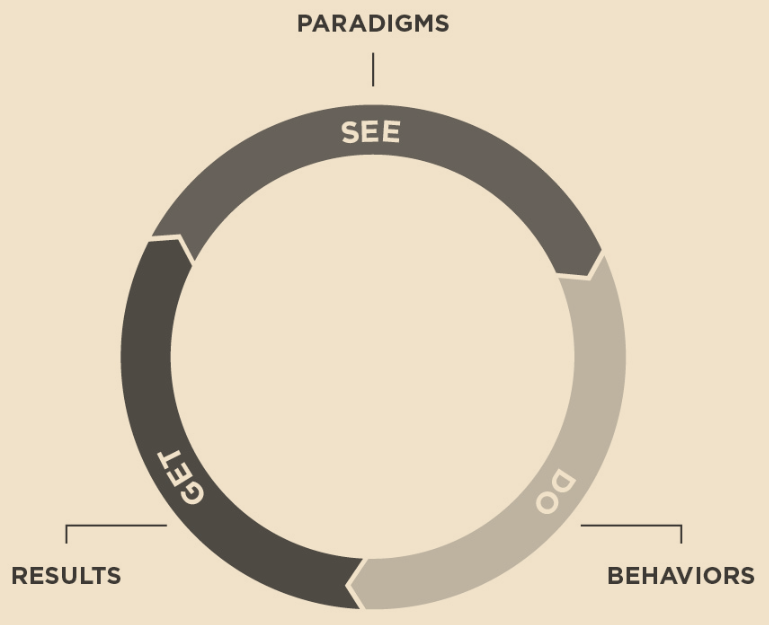
If you want to make minor improvements, change your behavior. But if you want to make quantum improvements, change your paradigm.
It’s been discovered that when people, teams, and organizations solely work on the do – the behaviors – they never get the results they seek. To get great results, you must first work on the see – the paradigms. New behaviors don’t stick unless you see them differently.
The 7 Habits of Highly Ineffective People
- Habit 1: react
Blame all your problems on your lousy boss, your parents, your genes, your spouse, your partner, your ex, the economy, the government, or something else. Be a victim. Take no responsibility for your life. If you’re hungry, eat. If you’re angry, yell. If someone says something rude to you, be rude back. React. - Habit 2: begin with squat in mind
Don’t plan ahead. Don’t set goals. And don’t worry about the consequences of your actions. Go with the flow. Live for the moment and party on, dude, for tomorrow you may die. - Habit 3: put first things last
Procrastinate. Do the urgent things first, like answering every ring, bling, and beep that comes your way. You’ll get to the important stuff later. Don’t worry about strengthening your relationships; they’ll always be there. And why exercise? You still have your health. Just make sure you spend sufficient time each day watching YouTube. - Habit 4: think win-lose
See life as a vicious competition. Everyone’s out to get you, so you’d better get them first. Don’t let others succeed, because remember, if they win, you lose. If it looks like you’re going to lose, however, make sure you drag that sucker down with you. - Habit 5: seek first to talk, then pretend to listen
You were born with a month, so use it. Talk a lot. Make sure everyone understands your views first; then, if you must, pretend to listen by saying “uh-huh” while daydreaming about what you want for lunch. Or if you really want their opinion, give it to them. - Habit 6: be an island
Let’s face it, other people are weird because they’re different from you, so why try to get along with them? Teamwork is overrated. Cooperation slows everything down, so bag it. Since you always have the best ideas, you’re better off just doing things by yourself. Be your own special island. - Habit 7: burn yourself out
I’m too busy driving to take time to get gas. Be too busy living to make time to recharge and renew. Don’t learn new things. Avoid exercise like the plague. And for heaven’s sake, stay away from good books, nature, art, music, or anything else that may inspire you.
Clearly, these are not the habits we are after. But too often, we practice them because they represent the course of least resistance.
 alin miu
Pingback: The 7 Habits of Highly Effective People – Part two: Private Victory | alin miu
Pingback: The 7 Habits of Highly Effective People – Part four: Renewal | alin miu