
You can easily see the importance of “striking at the roots” in other dimensions – for instance, when you compare the impact of focusing on preventing disease instead of merely treating it, or on preventing crime instead of simply enforcing the law. In this book, you begin to see it in business where, instead of compliance, the focus is on optimization through developing an ethical character, transparent motivation, and superb competence in producing sustained, superior results.

The key factor in a global economy
As we move rapidly into an even more transparent interdependent global reality, trust is more career-critical than it has ever been.
Low trust causes friction, whether it is caused by unethical behavior or by ethical but incompetent behavior (because even good intentions can never take the place of bad judgment). Low trust is the greatest cost in life and organizations, including families. Low trust creates hidden agendas, politics, interpersonal conflict, interdepartmental rivalries, win-lose thinking, defensive and protective communication – all of which reduce the speed of trust. Low trust slows everything – every decision, every communication, and every relationship.
On the other hand, trust produces speed. The greatest trust-building key is “results”. Results build brand loyalty. Results inspire and fire up a winning culture. The consistent production of results not only causes customers to increase their reorders, it also compels them to consistently recommend you to others.
The one thing that changes everything
Contrary to what most people believe, trust is not some soft, illusive quality that you either have or you don’t. Rather trust is a pragmatic, tangible, actionable asset that you can create- much faster than you probably think possible.
Restore trust is not only vital to our personal and interpersonal well-being; it is the key leadership competency of the new global economy.
You can have all the facts and figures, all the supporting evidence, all the endorsement that you want, but if you don’t command trust, you won’t get anywhere. by Niall Fitzgerald, Former Chairman, Unilever
Simply put, trust means confidence. The opposite of trust – distrust – is suspicion. When you trust people, you have confidence in them – in their integrity and in their abilities. When you distrust people, you are suspicious of them – of their integrity, their agenda, their capabilities, or their track record. It’s that simple. We have all had experiences that validate the difference between relationships that are built on trust and those that are not. These experiences clearly tell us the difference is not small, it is dramatic
The moment there is suspicion about a person’s motives, everything he does becomes tinted. – Mahatma Gandhi
Relationships of all kinds are built on and sustained by trust. They can also be broken and destroyed by lack of trust. Try to imagine any meaningful relationship without trust. In fact, low trust is the very definition of a bad relationship.
Here’s a simple formula that will enable you to take trust from an intangible and unquantifiable variable to an indispensable factor that is both tangible and quantifiable. The formula is based on this critical insight: Trust always affects two outcomes – speed and cost. When trust goes down, speed will also go down and costs will go up.
↓ Trust = ↓ Speed ↑ Cost
When trust goes up, speed will also go up and costs will go down.
↑ Trust = ↑ Speed ↓ Cost
It’s that simple, the real, that predictable. Let me share a couple of examples.
Immediately following the 9/11 terrorist attacks, trust in flying in the U.S. went down dramatically. Before 9/11, people used to arrive at the airport approximately half an hour before takeoff and were quickly able to go through security. However, after 9/11, more robust procedures and systems were put in place to increase safety and trust in flying. While these procedures have had their desired effect, now it takes longer and costs more to travel. People generally arrive an hour and a half before a domestic flight and two to three hours before an international flight to make sure they have enough time to clear security. They also pay an added 9/11 security tax with every ticket they buy. So, as trust went down, speed also went down, and cost went up.
The trust tax
You’ve undoubtedly seen this tax in action many times – perhaps in a conversation where you can tell that your boss, a friend, or someone else is automatically discounting everything you say by 20 percent, 30 percent, or even more. You’ve probably been the one taxing some of those interactions yourself, discounting what you’re hearing from others because you don’t trust them.
In some situations, you may even have had to pay an “inheritance tax” when you’ve stepped into a role that was occupied by someone who created distrust before you. When you move into a new personal or work relationship, or if you step in as a new leader in a low-trust culture, it’s possible that you’ve being taxed 30,40,50 percent, or more for something you didn’t even do!
The trust dividend
Just as the tax created by low trust is real, measurable, and extremely high, so the dividends of high trust are also real, quantifiable, and incredibly high.
(S x E)T = R
([Strategy times Execution] multiplied by Trust equals Results)
You could have good strategy and good execution (10 on a 1 to 10 scale) but still get derailed by low trust. High trust could serve as a performance multiplier, creating synergy where the whole is more than the sum of its parts. Just look at the math:
| Strategy | x | Execution | = | Result | Tax or dividend | = | Net Result |
| 10 | x | 10 | = | 100 | Less 40% tax | = | 60 |
| 10 | x | 10 | = | 100 | Less 10% tax | = | 90 |
| 10 | x | 10 | = | 100 | Plus 20% dividend | = | 120 |
One of the reasons why the hidden variable of trust is so significant and compelling in today’s world is that we have entered into a global, knowledge-worker economy.
A summary of taxes and dividends
| The 80% Tax (Nonexistent Trust) | |
| In the organization | In personal relationships |
| * dysfunctional environment and toxic culture (open warfare, sabotage, grievances, lawsuits, criminal behavior) * militant stakeholders * intense micromanagement * redundant hierarchy * punishing systems and structures | * dysfunctional relationships * hot, angry, confrontations or cold, bitter withdrawal * defensive posturing and legal positioning (“I’ll see you in court!”) * labeling of others as enemies or allies * verbal, emotional, and/or physical abuse |
| The 60% Tax (Very Low Trust) | |
| In the organization | In personal relationships |
| * unhealthy working environment * unhappy employees and stakeholders * intense political atmosphere with clear camps and parties * excessive time wasted defending positions and decisions * painful micromanagement and bureaucracy | * hostile behaviors (yelling, blaming, accusing, name-calling) followed by periods of brief contrition * guarded communication * constant worrying and suspicion * mistakes remembered and used as weapons * real issues not surfaced or dealt with effectively |
| The 40% Tax (Low Trust) | |
| In the organization | In personal relationship |
| * common “CYA” behavior * hidden agendas * militant stakeholders * political camps with allies and enemies * many dissatisfied employees and stakeholders * bureaucracy and redundancy in systems and structures | * Energy-draining and joyless interactions * evidence gathering of the other party’s weaknesses and mistakes * doubt about others’ reliability or commitment * hidden agendas * guarded (often grudging) dispersing of information |
| The 20% Tax (Trust Issues) | |
| In the organization | In personal relationships |
| * healthy workplace * good communication * aligned systems and structures * few office politics | * polite, cordial, healthy communications * a focus on working together smoothly and efficiently * mutual tolerance and acceptance * no worries |
| The 20% Dividend (Trust Is Not an Issue) | |
| In the organization | In personal relationships |
| * the focus is on work * effective collaboration and execution * positive partnering relationships with employees and stakeholders * helpful systems and structures * strong creativity and innovation | * cooperative, close, vibrant relationships * a focus on looking for and leveraging one another’s strengths * uplifting and positive communication * mistakes seen as learning opportunities and quickly forgiven * positive energy and positive people |
| The 40% Dividend (World-class Trust) | |
| In the organization | In personal relationships |
| * high collaboration and partnering * effortless communication * positive, transparent relationships with employees and all stakeholders * fully aligned systems and structures * strong innovation, engagement, confidence, and loyalty | * true joy in family and friendships, characterized by caring and love * free, effortless communication * inspiring work done together and characterized by purpose, creativity, and excitement * completely open, transparent relationships * amazing energy created by relationships |
Trust Myths
| MYTH | REALITY |
| trust is soft | trust is hard, real, and quantifiable. It measurably affects both speed and cost |
| trust is slow | nothing is as fast as the speed of trust |
| trust is built solely on integrity | trust is a function of both character(which includes integrity) and competence |
| you either have trust or you don’t | trust can be both created and destroyed |
| one lost, trust cannot be restored | though difficult, in most cases lost trust can be restored |
| you can’t teach trust | trust can be effectively taught and learned, and it can become a leverageable, strategic advantage |
| trusting people is too risky | not trusting people is a greater risk |
| trust can only be built on face-to-face | trust can be built on virtual teams and in digital environments |
| trust is established one person at a time | establishing trust with the one establishes trust with the many |
How trust works
Trust is one of the most powerful forms of motivation and inspiration. People want to be trusted. They respond to trust. They thrive on trust. Whatever our situation, we need to get good at establishing, extending, and restoring trust – not as a manipulative technique, but as the most effective way of relating to and working with others, and the most effective way of getting results. To do that, we first need to understand how trust works.
Trust is a function of two things: character and competence. Character includes your integrity, your motive, and your intent with people. Competence includes your capabilities, your skills, your results, and your track record. And both are vital.
With the increasing focus on ethics in our society, the character side of trust is fast becoming the price of entry in the new global economy. However, the differentiating and often ignored side of trust – competence – is equally essential. You might think a person is sincere, even honest, but you won’t trust that person fully if he or she doesn’t get results. And the opposite is true. A person might have great skills and talents and a good track record, but if he or she is not honest, you’re not going to trust that person either.
While it may come more naturally for us to think of trust in terms of character, it’s equally important that we also learn to think in terms of competence. Think about it – people trust people who make things happen. They give the new curriculum to their most competent instructors. They give promising projects or sales leads to those who have delivered in the past. Recognizing the role of competence helps us identify and give language to underlying trust issues we otherwise can’t put a finger on.
Here’s another way to look at it: the increasing concern about ethics has been good for our society. Ethics (which is part of character) is foundational to trust, but by itself is insufficient. You can’t have trust without ethics, but you can have ethics without trust. Trust, which encompasses ethics, is the bigger idea.
Character and competence are both necessary. Character is a constant; it’s necessary for trust in any circumstance. Competence is situational; it depends on what the circumstance requires.
Leadership theory deals with what the leader is (character) and what the leader does (competence).
The 5 waves of trust
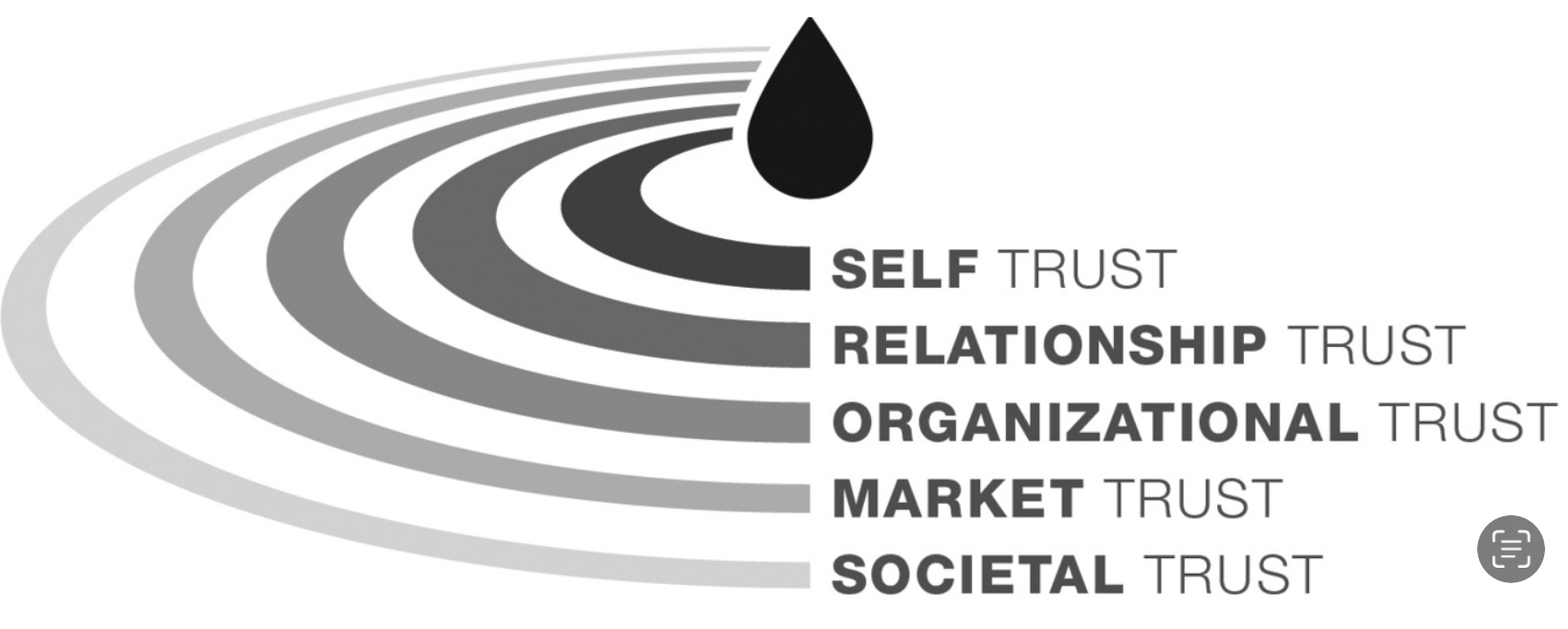
The first wave: self-trust
Deals with the confidence we have in ourselves – in our ability to set and achieve goals, to keep commitment, to walk our talk – and also with our ability to inspire trust in others. The whole idea is to become, both to ourselves and to others, a person who is worthy of trust.
It basically boils down to these four issues:
- your integrity
- your intent
- your capabilities
- and your results
Questionnaire: as you read the statements in each part, circle the number that best describes where you feel you are on the continuum: 1 means you identify with the statement on the left; 5 means you feel best described by the statement on the right. 2,3, or 4 mark various positions in between.
| Part One | ||
| I sometimes justify telling “white lies”, misrepresenting people or situations, or “spinning” the truth to get the results I want. | 1_2_3_4_5 | At every level, I am thoroughly honest in my interactions with others. |
| At times, there’s a mismatch between what I think and what I say, or between my actions and my values | 1_2_3_4_5 | What I say and do is what I really think and feel; I consistently “walk” my “talk” |
| I am not fully clear on my values. It’s difficult for me to stand up for something when others disagree. | 1_2_3_4_5 | I am clear on my values and courageous in standing up for them |
| It’s hard for me to acknowledge that someone else may be right, or that there is additional information out there that may cause me to change my mind | 1_2_3_4_5 | I am genuinely open to the possibility of learning new ideas that may cause me to rethink issues or even redefine values. |
| I have a difficult time setting and achieving personal goals or commitments | 1_2_3_4_5 | I can consistently make and keep commitments to myself and to others |
| Total score part one ______ | ||
| Part Two | ||
| I don’t really care that much about people, except those closest to me. It’s hard for me to think about concerns outside of my own challenges in life | 1_2_3_4_5 | I genuinely care about other people and am deeply concerned about the well-being of others |
| I don’t think a lot about why I do what I do. I’ve rarely (if ever) tried to do deep interior work to improve my motives | 1_2_3_4_5 | I am consciously aware of my motives and I refine them to make sure that I’m doing the right things for the right reasons |
| In my dealing with others, I usually focus on getting what I want | 1_2_3_4_5 | I actively seek solutions that provide a “win” for everyone involved |
| Based on my behavior, most people wouldn’t necessarily think I had their best interests in mind | 1_2_3_4_5 | Other people can clearly tell by the things I do that I really do have their best interest in mind |
| Deep down, I believe that if someone else gets something (resources, opportunities, credit), that means I don’t | 1_2_3_4_5 | I sincerely believe that there is more than enough of everything to go around |
| Total score part two ______ | ||
| Part Three | ||
| I feel like I’m not really utilizing my talents in my current job | 1_2_3_4_5 | There is a high match between my talents and my opportunities in the work I’m doing |
| I have not gained the knowledge or fully developed the skills I need to really be effective at work | 1_2_3_4_5 | I have acquired the knowledge and mastered the skills required for my job |
| I seldom take time to improve my knowledge and skills at work or in any other area of my life | 1_2_3_4_5 | I relentlessly upgrade and increase my knowledge and skills in all the important areas of my life |
| I am not really sure what my strengths are; I’m more focused on trying to improve in my areas of weakness | 1_2_3_4_5 | I’ve identified my strengths, and my greatest focus is on using them effectively |
| At this point, I really don’t know much about how to build trust | 1_2_3_4_5 | I know how to effectively establish, grow, extend, and restore trust, and I consciously work to make it happen |
| Total score part three ______ | ||
| Part Four | ||
| I don’t have a very good track record. My resume certainly won’t know anyone’s sock off | 1_2_3_4_5 | My track record clearly gives others the confidence that I will achieve the desired results |
| I focus my efforts on doing what I’ve been told to do | 1_2_3_4_5 | I focus my efforts on delivering results, not activities |
| When it comes to communicating my track record, either I don’t say anything (I don’t want to come across as bragging), or I say too much and turn people off | 1_2_3_4_5 | I appropriately communicate my track record to others in a way that inspires confidence |
| I often fail to finish what I start | 1_2_3_4_5 | With rare exceptions, if I start something, I finish it |
| I don’t worry as much about how I get the results – just that I get them | 1_2_3_4_5 | I consistently get results in ways that inspire trust |
| Total score part four______ | ||
| Total questionnaire score ______ |
If your total score is between 90 and 100, you have a high personal credibility. You demonstrate character and competence.
If your score is between 70 and 90, you may have a bit of a credibility gap, which will manifest itself either in lower self-trust or in some degree of failure to inspire the trust of others.
If you scored 70 or below, you likely have a more serious credibility problem. You may want to do some careful analysis of the specific areas in which you gave yourself lower marks.
Character is revealed not by how many powerful people you impress, but by how you treat people who lack power.– Adam Grant, Wharton Professor and author
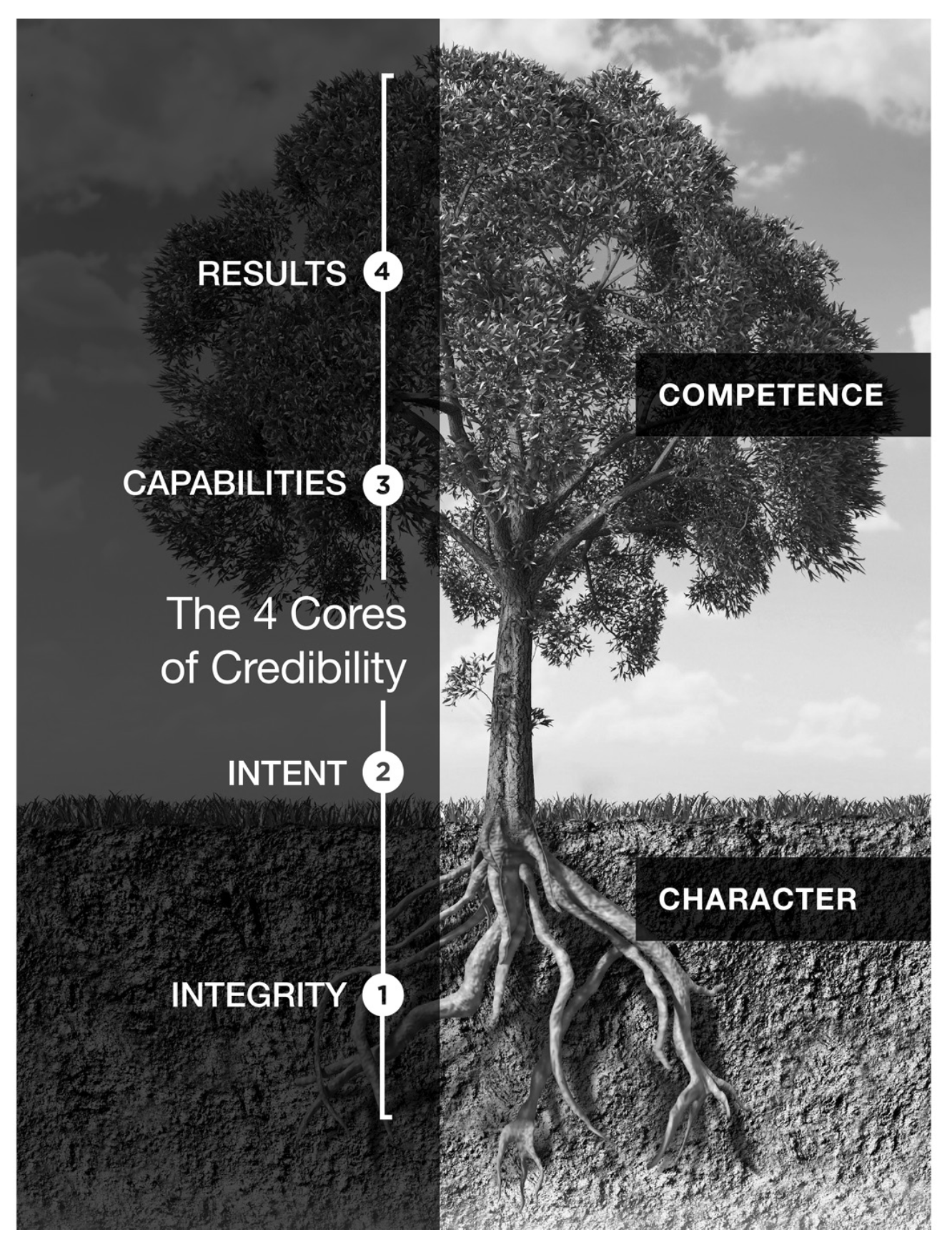
Core 1 – integrity
To have integrity only – and not the other three cores – is to be a “nice guy”, maybe even a thoroughly honest person, who is basically useless.
Captain Jack Sparrow in the movie Pirates of the Caribbean, then says: “I’m dishonest, and a dishonest man you can always trust to be dishonest … honestly. It’s the host ones you want to watch out for because you can never predict when they’re going to do something incredibly … stupid.”
A person has integrity when there is no gap between intent and behavior … when he or she is whole, seamless, the same – inside out.
The opposite of humility is arrogance and pride.
High-leveraged “accelerators” make a powerful difference in increasing integrity.
- Make and keep commitments to yourself
There is absolutely nothing you can do that will increase integrity faster than learning how to make and keep commitments to yourself.
Understand that when keeping your commitment becomes hard, you have two choices: you can change your behavior to match your commitment, or you can lower your values to match your behavior. One choice will strengthen your integrity; the other will diminish it and erode your confidence in your ability to make and keep commitments in the future. - Stand for something
You need to have a center. You need to have identified values. You need to know what you stand for and you need to stand for it, so that others know, too.
Core 2 – intent
It is important for us to actively influence the conclusions others draw by “declaring our intent”
- Examine and refine your motives
It’s human tendency to assume we have good – or at least, justifiable – intent. At times, our intent genuinely is good; at other times, we rationalize (tell ourselves “rational lies”) to justify our intent to ourselves and to others.
In an interaction with a work team: am I quick to see and acknowledge the contribution of every team member? Am I focused on a “win” for the entire team? Or am I primarily focused on my own “win” – on being the “hero”, on being recognized for my own ideas?
The key is simple: if your intent is based on principles (caring, contributing, seeking mutual benefit, acting in the best interest of others), it will bring you trust dividends; if it’s not, you’re going to be paying a tax.
“Five whys” with yourself in advance could have a significant effect on the content of the meeting and on the outcome. A sample from the book:- Why am I feeling unappreciated and undervalued?
Because I don’t think the people around here see the good work I do. - Why do I think they don’t see the good work I do?
Because they seem to be totally focused on the new blood – the “rising stars” - What makes me think they’re focused on the rising stars? The fact that Sarah got promoted last week -and it should have been me!
- Why do I think Sarah got promoted instead of me?
I don’t know. Maybe that’s what I really want to talk to my boss about. - Why do I want to talk to the boss about it?
Well, I suppose my original intent was to vent and complain about Sarah’s promotion. But I guess what I really want to understand is what I can do to add more value to the company so that I will be considered more seriously when future promotions come around.
- Why am I feeling unappreciated and undervalued?
- Declare your intent
Declaring your intent and expressing your agenda and motives can be very powerful, particularly if your behavior is being misinterpreted or misconstructed by others. It’s also valuable as a means of establishing trust in new relationships. Response, then, is much like what happens when someone buys a new car and then suddenly starts noticing the same kind of car everywhere on the road. It’s not that there are suddenly more of those cars on the road; it’s that their awareness is enhanced. - Choose abundance
Abundance means that there is enough for everybody. The opposite – scarcity – says that there is only so much to go around, and if you get it, I won’t. While scarcity may be a reality in some areas (such as competitive sports or forced grading curves), in most of the important things in life – such as love, success, energy, results, and trust – abundance is not only a reality, it is an attractor and generator of even more.
The important thing to understand is this: abundance is a choice!
Core 3 – capabilities
An experience the author had some years ago making a presentation to generals in the air force of a small country. He asked one of the generals about the effectiveness of their 360-degree feedback process where the pilots rated one another’s capabilities. He wanted to know how they keep it from becoming a “you scratch my back, I’ll scratch yours” situation in which pilots would praise one another’s capabilities so that both could get promoted. Evidently, the general was completely taken aback by the question. In essence, he said, “Don’t you realize that we are surrounded by our enemies on every side, and our very survival as a nation depends upon our skill? No one would even think of misrepresenting the capabilities of anyone on this force.”
Left untended, knowledge and skill, like all assets, depreciate in value – surprisingly quickly. – David Maister, business author and consultant
One way to think about the various dimensions of capabilities is to use the acronym “TASKS”
- Talents – are our natural gifts and strengths.
- Attitudes – represent our paradigms – our ways of seeing, as well as our ways of being.
- Skills – are our proficiencies, the things we can do well.
- Knowledge – represents our learning, insight, understanding, and awareness.
- Style – represents our unique approach and personality.
Clearly, there is a wide variety of effective styles. The challenge is to match the style to the highest effectiveness for the task. The problem comes when you have a “style” that gets in the way and creates distrust.
How to increase your capabilities
- Run with your strengths (and with your purpose)
The idea here is simply to identify your strengths (whether they are Talents, Attitudes, Skills, Knowledge, or Style), and then focus on engaging, developing, and leveraging what’s distinctly yours. - Keep yourself relevant
For years, people have recognized the value of a four-year degree, but to succeed in today’s economy, you really need a forty-year degree. In other words, you need to be engaged in lifelong learning. The four-year degree may teach you how to read, write, think, and reason, but its main purpose is to set you up for ongoing learning. - Know where you’re going
Key to leadership – “At the end of the day, people follow those who know where they’re going.”
Trust abilities
While character is constant, competence – at least most competence – is situational. It depends on what the circumstance requires.
Core 4 – results
You can’t create a high-trust culture unless people perform. – Craig Weatherup, former CEO, PepsiCo
People don’t trust you because you don’t get things done. And there’s no place to hide here -either you produce or you don’t. You may have excuses. You may even have good reasons. But at the end of the day, if the results aren’t there, neither is the credibility and neither is the trust. It’s just that simple; it’s just that harsh.
The Performance-Values Matrix, originally popularized by GE, recognizes four possibilities that illustrate the dynamic between “getting results” and “living the values”. It’s fairly easy to know what to do with the first category of people, who both deliver results and live the values. They should be retained and promoted. It’s also fairly easy to know what to do with the second category, who neither deliver results nor live the values. They should be let go.
The other two categories, however, are tougher to deal with. Those who live the values but achieve low results can often be trained, coached, or moved to another role. If they don’t improve, they may need to be let go. The hardest of all to deal with are those who have high results but are poor in living the values. They achieve the end that everybody wants, but they do it in a way that blatantly defies organizational values. People in this category need to learn to operate within the company’s values – or be let go, despite their results.
Results -past, present, and future
There are three key indicators by which people evaluate results. One is past performance – your track record, your reputation, the things you’ve done, and the results you’ve already achieved. Another is current performance – how you are performing today. And the third is anticipated performance – how people think you will perform in the future.
“What’ and “How”
In considering results, you always need to ask two critical questions: What results am I getting? and How am I getting those results?
For example, suppose you get your team to hit the numbers, but in the process, you create an adversarial win-lose competition between team members, push them until they reach burnout, and take all the credit for your team’s performance. What’s going to be the attitude of those team members the next time you challenge them to hit the numbers?
On the other hand, suppose you hit the numbers, but you do it by creating a team spirit of abundance and collaboration. You help team members work together so that everyone succeeds, no one reaches burnout, and the credit is freely shared. What’s going to be their attitude the next time the challenge comes up? What if you can get the same great results – only this time, it’s going to be 30 percent faster and easier?
The how can generate huge roadblocks to future results -or it can grease the skids. It’s so much easier to get results the next time around if people trust you … if they know you’re going to give credit, to seek mutual benefit, to not place blame.
The second wave: relationship trust
Is about how to establish and increase the “trust accounts” we have with others. The key principle underlying this wave in consistent behavior, and in this section, we will cover 13 key behaviors common to high-trust leaders around the world.
You can’t talk yourself out of a problem you’ve behaved yourself into. – Stephen R. Covey
No, but you can behave yourself out of a problem you’ve behaved yourself into … and often faster than you think! – Stephen M.R. Covey
People don’t listen to you speak; they watch your feet. – Anonymous
The quickest way to decrease trust is to violate a behavior of character, while the quickest way to increase trust is to demonstrate a behavior of competence.
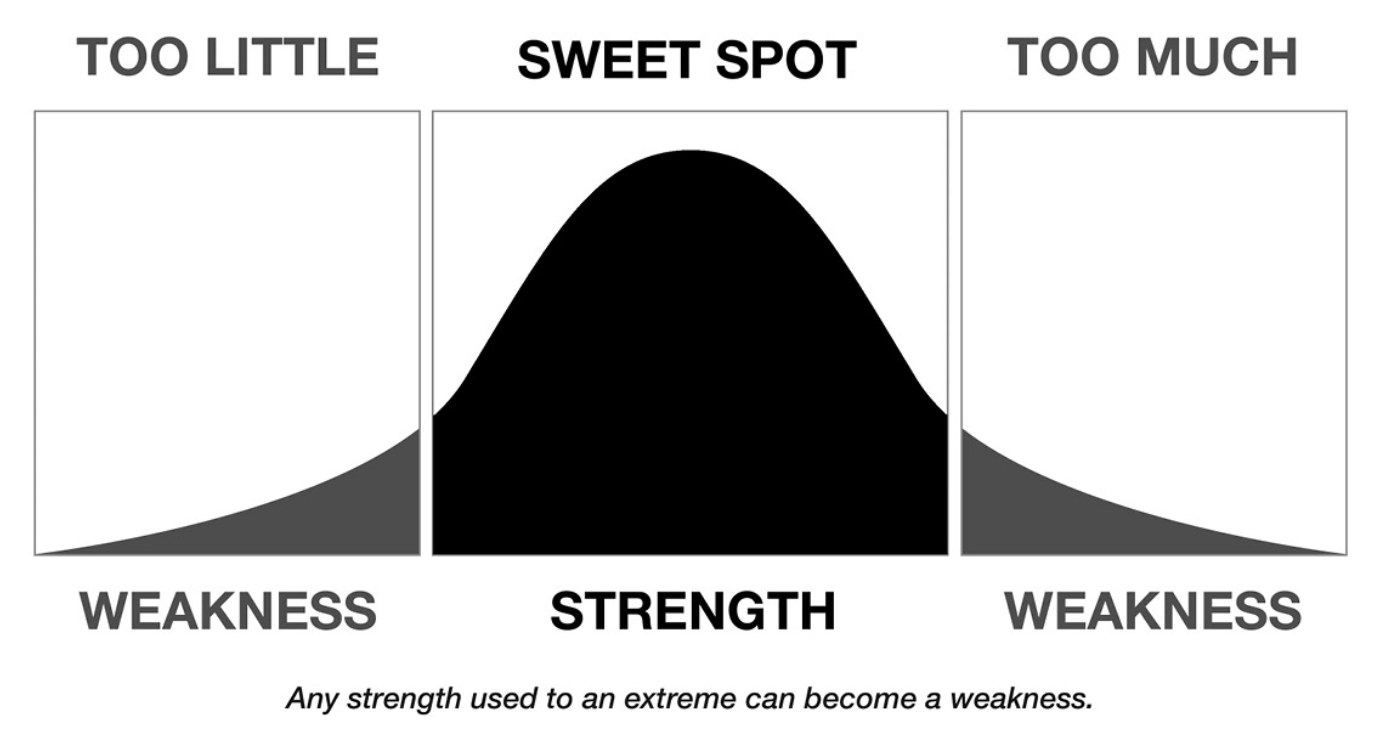
The 13 behaviors
- Talk straight
Be honest. Tell the truth. Let people know where you stand. Use simple language. Call things what they are. Demonstrate integrity. Don’t manipulate people or distort facts. Don’t spin the truth. Don’t leave false impressions. - Demonstrate respect
Genuinely care for others. Show you care. Respect the dignity of every person and every role. Treat everyone with respect, especially those who can’t do anything for you. Show kindness in the little things. Don’t fake caring. Don’t attempt to be “efficient” with people. - Create transparency
Tell the truth in a way people can verify. Declare your intent. Gel real and be genuine. Be open and authentic. Err on the side of disclosure. Be transparent about not being able to be transparent (e.g. when the law or ethics preclude it). Operate on the premise of “What you see is what you get.” Don’t have hidden agendas. Don’t hide information. - Right wrongs
Make things right when you’re wrong. Apologize quickly. Make restitution where possible. Practice “service recoveries.” Demonstrate humility. Don’t cover things up. Don’t let pride get in the way of doing the right thing. - Show loyalty
To retain those who are present, be loyal to those who are absent. – Stephen R. Covey
Give credit to others. Speak about people as if they were present. Represent others who aren’t there to speak for themselves. Don’t bad-mouth others behind their backs. When you must talk about others, check your intent. Don’t disclose others’ private information. - Deliver results
Establish a track record of results. Get the right things done. Make things happen. Accomplish what you’re hired to do. Be on time and within budget. Don’t overpromise and underdeliver. Don’t make excuses for not delivering. - Get better
Two strategies that are particularly helpful in maximizing your effort: are seeking feedback, and learning from mistakes.
Continuously improve. Increase your capabilities. Be a constant learner. Developer feedback systems – both formal and informal. Act on the feedback you receive. Thank people for your feedback. Don’t consider yourself above feedback. Don’t assume today’s knowledge and skills will be sufficient for tomorrow’s challenges. - Confront reality
Take issues head-on, even the “undiscussable”. Address the tough stuff directly. Acknowledge the unsaid. Confront issues before they turn into major problems. Confront the reality, not the person. Remove the “sword from their hands”. Lead out courageously in conversations. Don’t skirt the real issues. Don’t bury your head in the sand. - Clarify expectations
Disclose and reveal expectations. Discuss them. Validate them. Renegotiate them if needed and possible. Don’t violate expectations. Don’t assume that expectations are clear or shared. - Practice accountability
Hold yourself accountable first; hold others accountable second. Take responsibility for results, good or bad. Be clear on how you’ll communicate how you’re doing – and how others are doing. Don’t avoid or shirk responsibility. Don’t blame others or point fingers when things go wrong. - Listen first
We’ve all heard the criticism “he talks too much”. When was the last time you heard someone criticized for listening too much? – Norm Augustine, former chairman, Lockheed Martin
Two keys that may be helpful to you in working on results:
First, generally, as long as a person is communicating with high emotion, he or she does not yet feel understood.
Second, a person will usually not ask for your advice until he or she feels understood. To offer advice too early will usually only stir up more emotion – or cause someone to simply ignore what you say.
Listen before you speak. Understand. Diagnose. Listen with your ears – and your eyes and heart. Find out what the most important behaviors are to the people you’re working with. Don’t assume you know what matters most to others. Don’t presume you have all the answers – or all the questions. - Keep commitments
Say what you’re going to do, then do what you say you’re going to do. Make commitments – both explicit and implicit – very careful, and keep them at almost all costs. Communicate when you can’t. Make keeping commitments the symbol of your honor. Don’t break confidences. Don’t attempt to “spin” your way out of a commitment you’ve broken. - Extend trust
In fact, when people are asked to think of the person who has been most influential in their lives and to describe why that person was so influential, they will usually say, “She believed in me when no one else did”, or “He saw something in me that no one else saw”. What they are basically saying is that that person trusted them and that they were powerfully influenced by and responded to that trust.
Demonstrate a propensity to trust. Extend trust abundantly to those who have earned your trust. Extend trust conditionally to those who are earning your trust. Learn how to appropriately extend trust to others based on the situation, risk, and credibility (character and competence) of the people involved. But start with a propensity to trust. Don’t withhold trust because there is risk involved.
| BEHAVIOR | CURRENT PERFORMANCE | OPPOSITE/COUNTERFEIT |
| Talk straight | 1_2_3_4_5 | Lie, spin, tell half-truths, double-talk, flatter |
| Demonstrate respect | 1_2_3_4_5 | Don’t care or don’t show you care; show disrespect or show respect only to those who can do something for you |
| Create transparency | 1_2_3_4_5 | Withhold information; keep secretes; create illusions; pretend |
| Right wrongs | 1_2_3_4_5 | Don’t admit or repair mistakes; cover up mistakes |
| Show loyalty | 1_2_3_4_5 | Sell others out; take the credit yourself; sweet-talk people to their faces and bad-mouth them behind their backs |
| Deliver results | 1_2_3_4_5 | Fail to deliver; deliver on activities, not results |
| Get better | 1_2_3_4_5 | Deteriorate; don’t invest in improvement; force every problem into your one solution |
| Confront reality | 1_2_3_4_5 | Bury your head in the sand; focus on busywork while skirting the real issues |
| Clarify expectations | 1_2_3_4_5 | Assume expectations or don’t disclose them; create vague and shifting expectations |
| Practice accountability | 1_2_3_4_5 | Don’t take responsibility; “It’s not my fault!”; don’t hold others accountable |
| Listen first | 1_2_3_4_5 | Don’t listen; speak first; listen last; pretend to listen; listen without understanding; |
| Keep commitments | 1_2_3_4_5 | Break commitments; violate promises; make vague and elusive commitments or don’t make any commitments |
| Extend trust | 1_2_3_4_5 | Withhold trust; fake trust and then supervise; give responsibility without authority |
Smart Trust
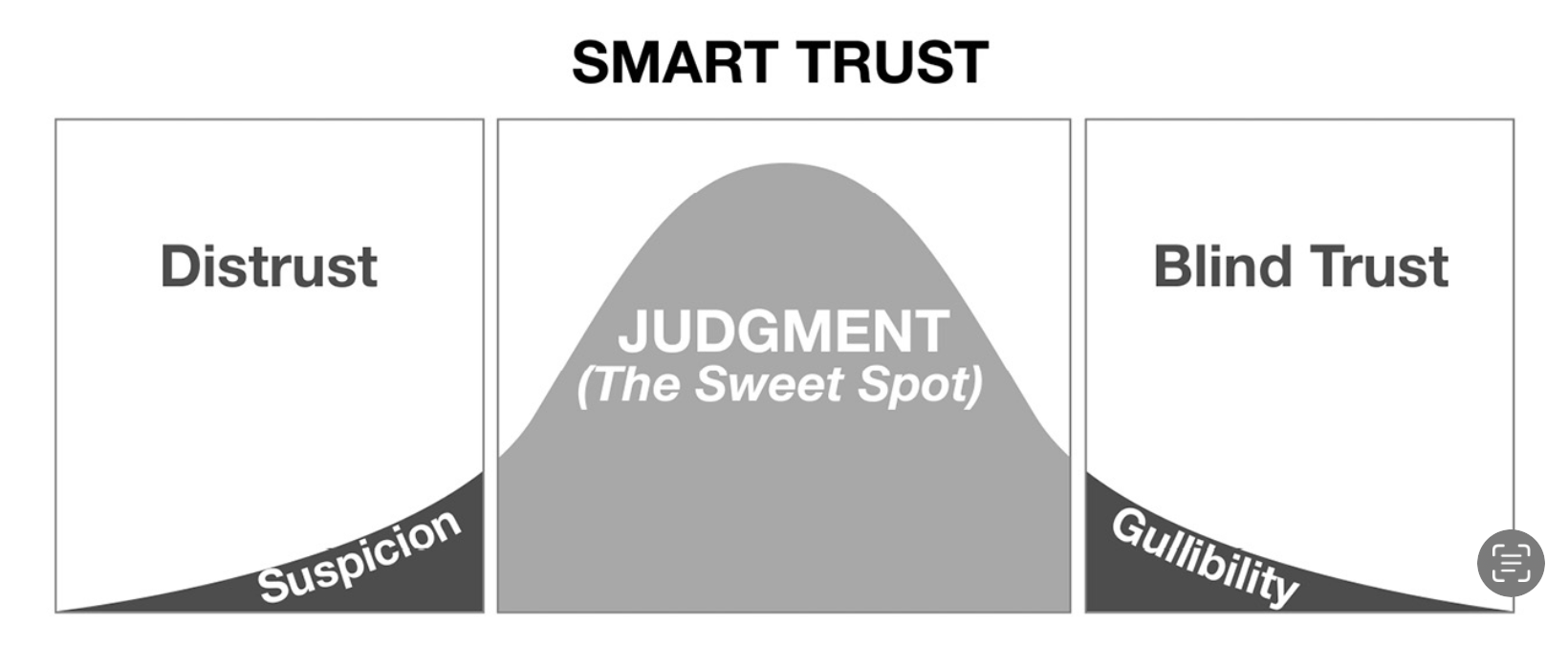
When you’re dealing with trust, it seems there are two extremes. On one end of the spectrum, people don’t trust enough. They’re suspicious. They hold things close to the vest. Often the only people they really trust are themselves. On the other end, people are too trusting. They’re totally gullible. They believe in anyone and trust everyone. They have a simplistic, naive view of the world, and they don’t even really think (except superficially) about the need to protect their interests.
The “smart trust” matrix
“Propensity to Trust” is primarily a matter of the heart. It’s the tendency, inclination, or predisposition to believe that people are worthy of trust and desire to extend it to them freely. The degree to which you have this tendency may be due to your inherent personality, to the way important people in your life have (or have not) trusted you, or to your own experience (good or bad) in trusting others – or, most likely, to a combination of these factors.
“Analysis” is primarily a matter of the mind. It’s the ability to analyze, evaluate, theorize, consider implications and possibilities, and come up with logical decisions and solutions. Again, the degree to which you have “strong analysis” may be due to a variety or combination of factors, including your natural gifts or abilities, your education and the way you think, your style, and/or your life experience.
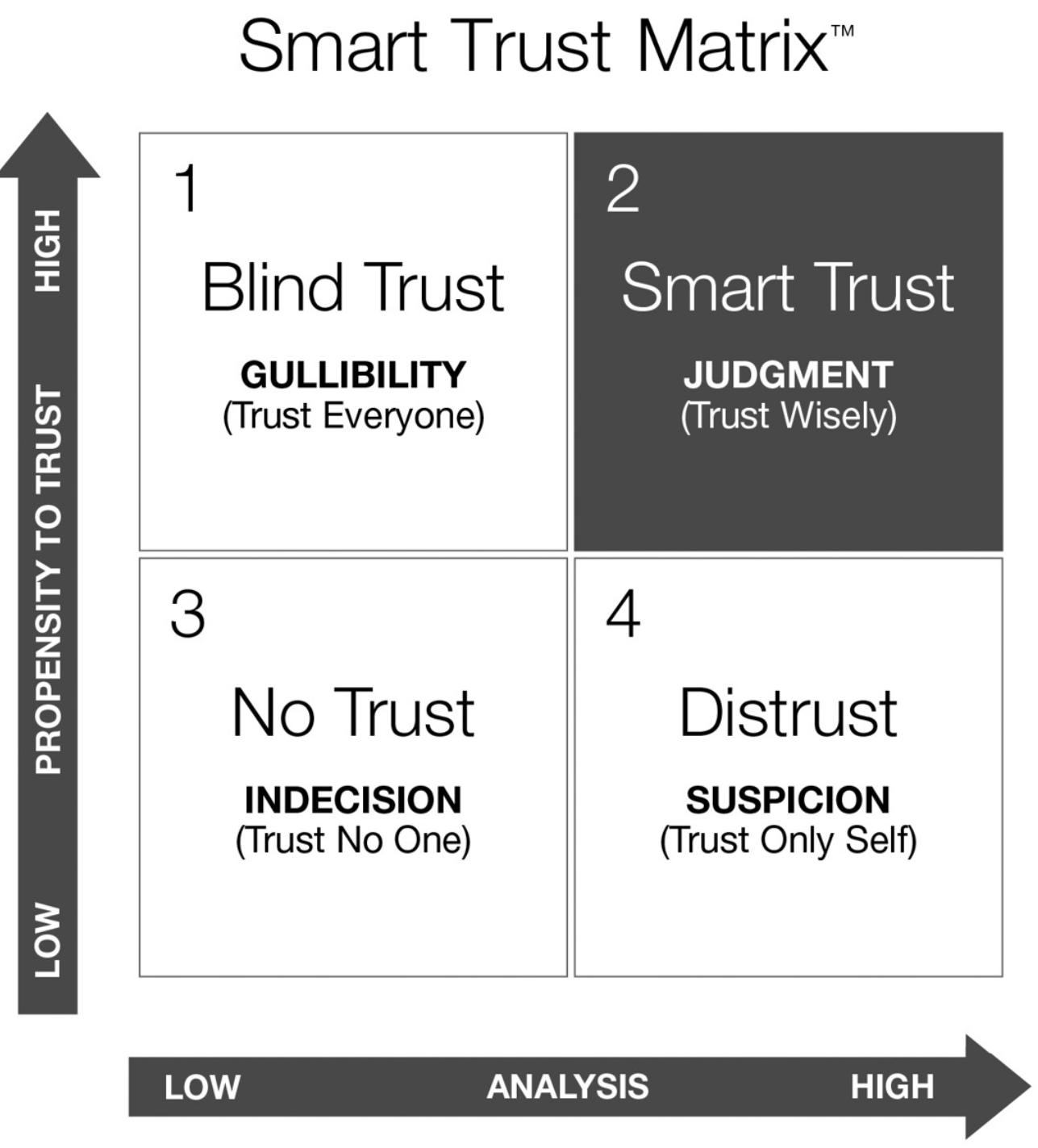
Trust, but verify. – Ronald Reagan
Why many trusted managers never become leaders
“Leadership” is getting results in a way that inspires trust. Many trusted managers – credible people who have high character and technical competence – never become “leaders” because they don’t know how to extend Smart Trust. They essentially operate in Zone 4(distrust), the zone of suspicion.
The third wave: organizational trust
Deals with how leaders can generate trust in all kinds of organizations. The key principle underlying this wave, alignment, helps leaders create structures, systems, and symbols of organizational trust that decrease or eliminate seven of the most insidious and costly organizational trust taxes.
Organizations are no longer built on force but on trust. – Peter Drucker
Low-trust organizations, they see cultural behaviors such as the following:
- people manipulate or distort facts
- people withhold and hoard information
- getting the credit is very important
- people spin the truth to their advantage
- new ideas are only openly resisted and stifled
- mistakes are covered up and covered over
- most people are involved in a blame game, bad-mouthing others
- there is an abundance of watercooler talk
- there are numerous “meetings after the meetings”
- there are many “undiscussable”
- people tend to overpromise and underdeliver
- there are a lot of violated expectations, for which people try to make excuses
- people pretend bad things aren’t happening or are in denial
- the energy level is low
- people often feel unproductive tension – sometimes even fear
High-trust organizations, they typically see the behaviors, such as these:
- information shared openly
- mistakes are tolerated and encouraged as a way of learning
- the culture is innovative and creative
- people are loyal to those who are absent
- people talk straight and confront real issues
- there is real communication and real collaboration
- people share credit abundantly
- there are few “meetings after the meeting”
- transparency is a practiced value
- people are candid and authentic
- there is a high degree of accountability
- there is palpable vitality and energy – people can feel the positive momentum
Work hard, work Smart, and have Fun.
A trusted leader can only exist over the long term in a large organization if there are good myths about him, particularly about his consistency. – Henk Broeders, head of Cap Gemini, E&Y for the Netherlands
The core of the matter is always changing the behavior of people. – Professor John Kotter, Harvard Business School
Ultimately you’ll want to make sure that leadership paradigms are aligned with the principles that create trust. When leaders fundamentally don’t believe people can be trusted, they create systems and structures that reflect that belief, such as a hierarchy, multiple layers of management, and cumbersome processes. In turn, these systems and structures ultimately help produce the distrusting behaviors that validate the leaders’ perceptions that people can’t be trusted in the first place. It becomes a vicious, downward cycle.
7 low-trust organizational taxes
- Redundancy
A redundancy tax is paid in excessive organizational hierarchy, layers of management, and overlapping structures all designed to ensure control. - Bureaucracy
It’s reflected in excessive paperwork, red tape, controls, multiple approval layers, and government regulations.
When trust is absent, you can see it – more checks, more controls. And processes. That’s bureaucracy. – Randall Stephenson, chairman and CEO, AT&T - Politics
“Politics” is defined as the use of tactics and strategy to gain power. In fact in many ways, “politics” is an antonym for trust. - Disengagement
Which came first, the chicken (distrust) or the egg (disengagement)? It’s a self-perpetuating cycle that gradually grinds the organization to a crippled pace, or even to a halt. - Turnover
Performers like to be trusted and they like to work in high-trust environments. When they’re not trusted, it’s insulting to them, and a significant number will ultimately seek employment where they’re trusted. - Churn
- Fraud
7 high-trust organizational dividends
- Increased value
- Accelerated growth
- Enhanced innovation
- Improved collaboration
With low trust, collaboration is merely coordination – or at best, cooperation – both of which fail to achieve the benefits and possibilities available to true collaborators in our digital and disruptive world. - Stronger partnering
Real trust is not naive. It … is earned from performance - Better execution
When there’s low trust, everything takes longer and costs more – or gets derailed altogether.
We still have to create a good strategy and execute it well. Put simply: high trust won’t necessarily rescue a lousy strategy, but low trust will almost always derail a good one. At a minimum, low trust will slow it down. - Heightened loyalty
The fourth wave: market trust
Is the level at which almost everyone clearly understands the impact of trust. The underlying principle behind this wave is reputation. It’s about your company brand (as well as your personal brand), which reflects the trust customers, investors, and others in the marketplace have in you.
The fifth wave: societal trust
Is about creating value for others and for society at large. The principle underlying this wave is contribution. By contributing or “giving back”, we counteract the suspicion, cynicism, and low-trust inheritance taxes within our society. We also inspire others to create value and contribute, as well.
See/Speak/Behave
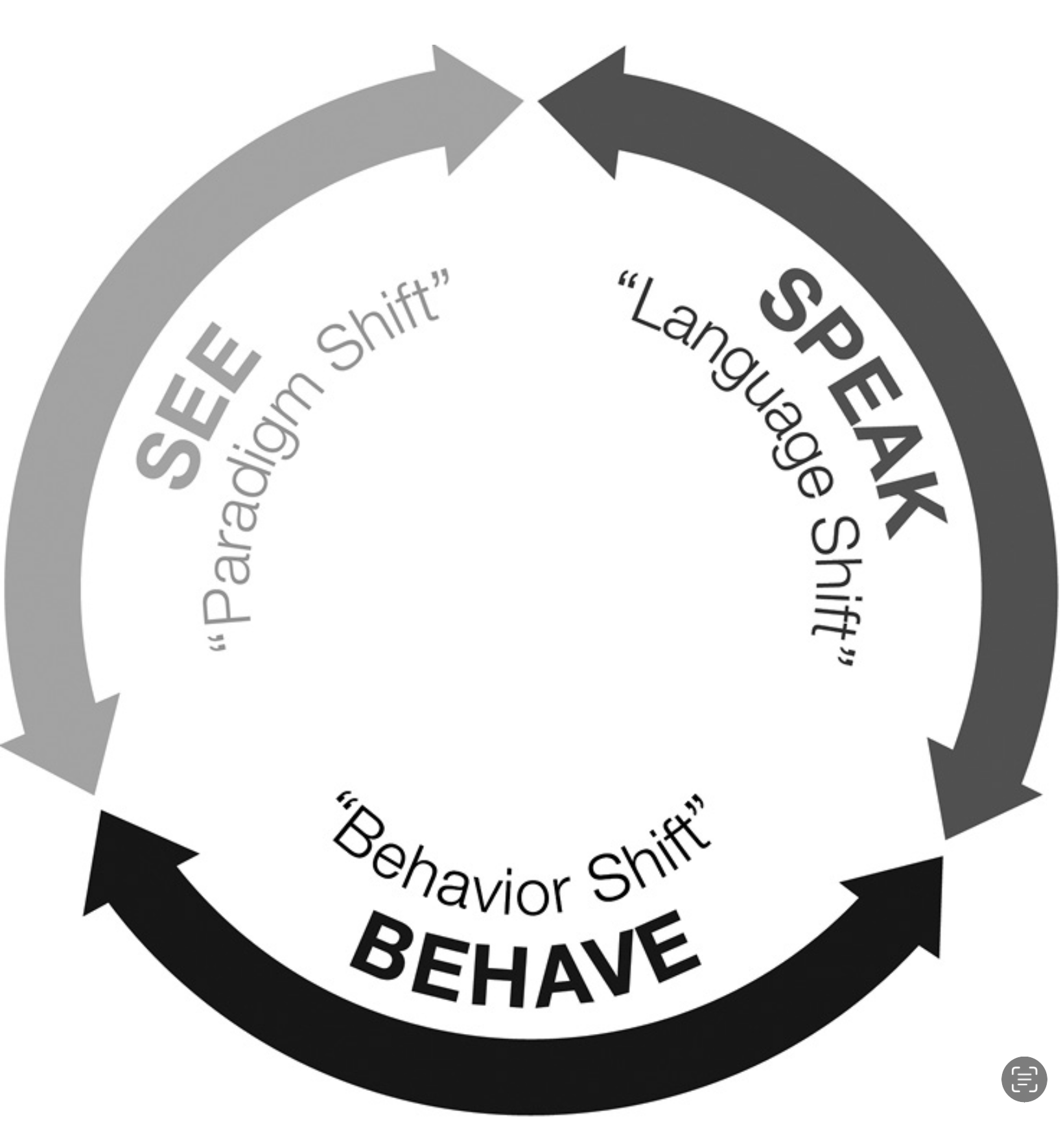
Clearly, these three dimensions are interdependent, and whenever you effect a change in one dimension, you effect a change in all three.
Restoring trust
People tend to judge others based on behavior and judge themselves based on intent.
The idea that trust cannot be restored once is lost is a myth. Though it may be difficult, in most cases, lost trust can be restored – and often even enhanced!
One of the greatest obstacles to building and restoring trust is the superficial, two-dimensional paradigm that the ideal life is challenge-free. It’s not. We are going to have challenges. We are going to make mistakes. And others are going to make mistakes that affect us. That’s life. The issue is how we respond to those things – whether or not we choose to prioritize the enormous long-term dividends of trust over whatever temporary satisfaction we may get from doing things that break trust, trying to justify low-trust behavior, holding grudges, or failing to forgive.
When you have lost the trust of others
Whether you lose the trust of others through a conscious act of betrayal, poor judgment, an honest mistake, a failure of competence, or a simple misunderstanding, the path to restoration is the same – to increase your personal credibility and behave in ways that inspire trust.
Generally speaking, a loss of trust created by a violation of character (Integrity or Intent) is far more difficult to restore than a loss of trust created by a violation of competence (Capabilities or Results). Violations of Integrity are the most difficult of all to restore in all relationships, whether they are personal, family, professional, organizational, or in the marketplace.
Keep in mind that when you talk about restoring trust, you’re talking about changing someone else’s feelings about you and confidence in you. And that’s not something you can control. You can’t force people to trust you. You can’t make them have confidence in you. They may be dealing with other issues in their own lives that make the challenge more difficult for them. Or they may have interpreted a breach of competence on your part as a breach of character, which significantly complicates the issue. The point is that you can only do what you can do. But that’s a lot.
 alin miu