
The self-management competencies defined by Daniel Goleman model, each had become fads, but under different names after the introduction of this book. Positivity has been called “growth mindset”, achievement “grit”, adaptability “agility”, and emotional regulation “resilience”. Each of these emotional intelligence abilities matter – but all share a weakness if taken alone: they lack empaty and all the rest of the social skills found in the relationship management part of EI.
Part one – the emotional brain
In our emotional repertoire each emotion plays a unique role, as revealed by their distinctive biological signatures. With new methods o peer into the body and brain, researchers are discovering more physiological details of how each emotion prepares the body for a very different kind of response:
- with anger blood flows to the hands, making it easier to grasp a weapon or strike at a foe; heart rate increases and a rush of hormones such as adrenaline generates a pulse of energy strong enough for rigorous action
- with fear blood goes to the large skeletal muscles, such as in the legs, making it easier to flee – making the face blanch as blood is shunted away from it (creating the feeling that the blood “runs cold”). At the same time, the body freezes, if only for a moment, perhaps allowing time to gauge whether hiding might be a better reaction. Circuits in the brain’s emotional centers trigger a flood of hormones that put the body on general alert, making it edgy and ready for action, and attention fixates on the threat at hand the better to evaluate what response to make.
- happiness is an increased activity in a brain center that inhibits negative feelings and fosters a increase in available energy and a quieting of those that generate worrisome thoughts. But there is no particular physiological shift save a quiescence which makes the body recover more quickly from the biological arousal of upsetting emotions. This configuration offers the body a general rest, as well as readiness and enthusiasm for whatever task is at hand and for striving toward a great variety of goals
- love, tender feelings, and sexual satisfaction entail parasympathetic arousal – the physiological opposite of the “fight-or-flight” mobilization shared by fear and anger. The parasympathetic pattern, dubbed the “relaxation response”, is a bodywide set of reaction that generates a general state of calm and contentment, facilitating cooperation.
- the lifting of the eyebrows in surprise allows the taking of a larger visual sweep and also permits more light to strike the retina. This offers more information about the unexpected event, making it easier to figure out exactly what is going on and concoct the best plan for action.
- around the world an expression of disgust looks the same, and sends the identical message: something is offensive in taste or smell, or metaphorically so. The facial expression of disgust – the upper lip curled to the side as the nose wrinkles slightly – suggests a primordial attempt, as Darwin observed, to close the nostrils against a noxious odor or to spit out a poisonous food.
- main function for sadness is to help adjust to a significant loss, such as the death of someone close or major disappointment. Sadness brings a drop in energy and enthusiasm for life’s activities, particularly diversions and pleasures, and, as it deepens and approaches depression, sows the body’s metabolism. This introspectie withdrawal creates the opportunity to mourn a loss or frustrated hope, grasps its consequences for one’s life, and, as energy returns, plan new beginnings. This loss of energy may well have kept saddened – and vulnerable – early humans close to home, where they were safer.
The emotional sentinel
The amygdala can have us spring to action while the slightly slower – but more fully informed – neocortex unfolds its more refined plan for reaction.
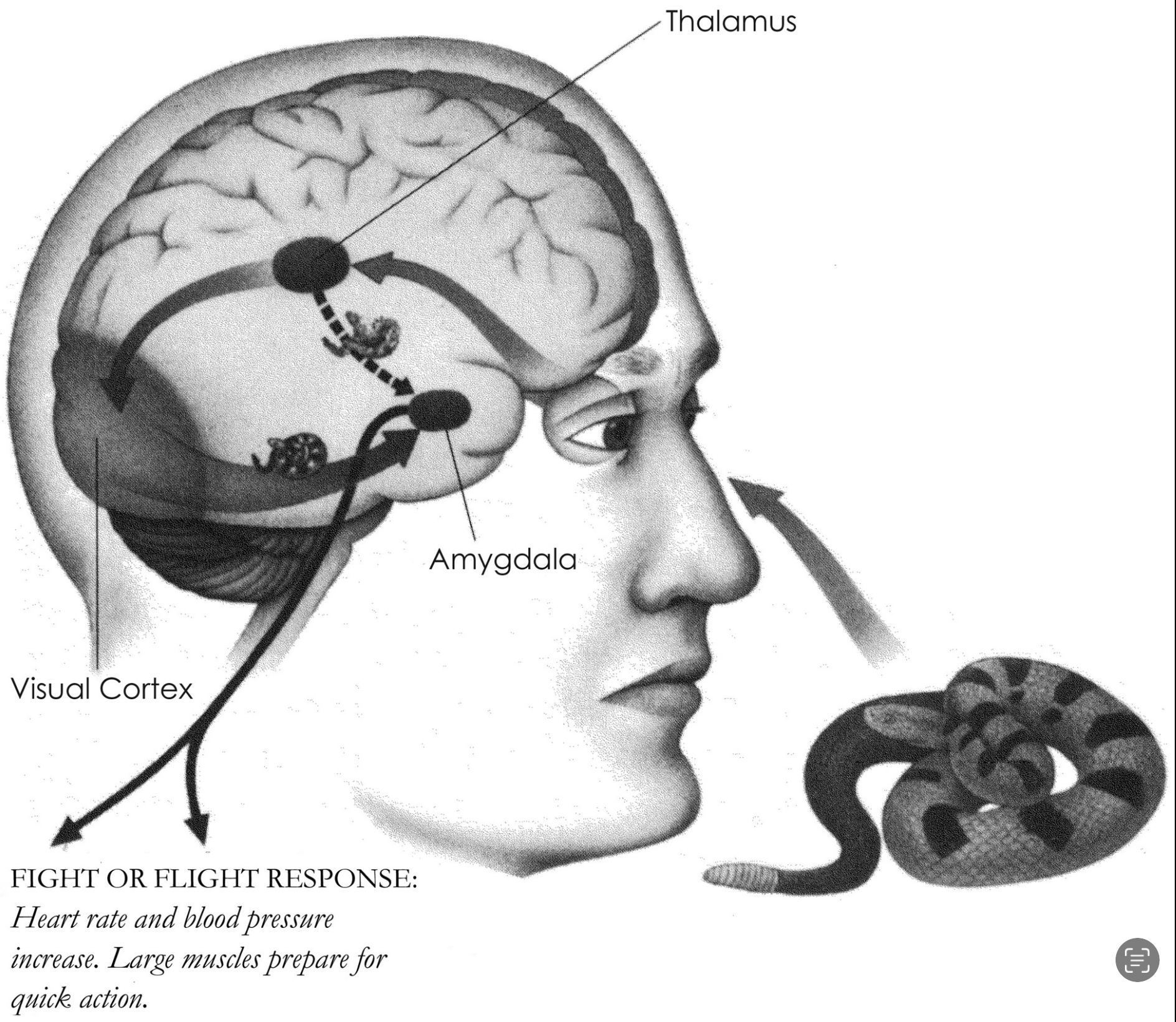
A visual signal first goes from the retina to the thalamus where it is translated into the language of the brain. Most of the message then goes to the visual cortex, where it is analyzed and assessed for meaning and appropriate response; if that response is emotional, a signal goes to the amygdala to activate the emotional centers. But a smaller portion of the original signal goes straight from the thalamus to the amygdala in a quicker transmission, allowing a faster (though less precise) response. Thus the amygdala can trigger an emotional response before the cortical centers have fully understood what is happening.
In a sense we have two brains – and two different kinds of intelligence rational and emotional. How we do in life is determined by both – it is not just IQ, but emotional intelligence that matters. Indeed, intellect cannot work at its best without emotional intelligence. Ordinarily the complementarity of limbic system and neocortex, amygdala and prefrontal lobes, means each is a full partner in mental life. When these partners interact well, emotional intelligence rises – as does intellectual ability.
Part two – the nature of emotional intelligence
Emotional intelligence abilities such as being able to motivate oneself and persist in the face of frustrations; to control impulse and delay gratification; to regulate one’s moods and keep distress from swamping the ability to think; to empathize and to hope.
Interpersonal intelligence is the ability to understand other people: what motivates them, how they work, how to work cooperatively with them. Successful salespeople, politicians, teachers, clinicians, and religious leaders are all likely to be individuals with high degrees of interpersonal intelligence. Intrapersonal intelligence… is a correlative ability, turned inward. It is a capacity to form an accurate, veridical model of oneself and to be able to use that model to operate effectively in life.
Elaborated definition of emotional intelligence:
- knowing one’s emotions. Self-awareness – recognizing a feeling as it happens – is the keystone of emotional intelligence.
- managing emotions. Handling feelings so they are appropriate is an ability that builds on self-awareness.
- motivating oneself. Marshaling emotions in the service of a goals is essential for paying attention, for self-motivation and mastery, and for creativity. Emotional self-control – delaying gratification and stifling impulsiveness – underlies accomplishment of every sort. And being able to get into the “flow” state enables outstanding performance of all kinds. People who have this skill tend to be more highly productive and effective in whatever they understake.
- recognizing emotions in others. Empathy, another ability that builds on emotional self-awareness, is the fundamental “people skill”
- handling relationships. The art of relationships is, in large part, skill in managing emotions in others.
IQ and emotional intelligence are not opposing competencies, but rather separate ones. We all mix intellect and emotional acuity; people with a high IQ but low emotional intelligence (or low IQ and high emotional intelligence) are, despite the stereotypes, relatively rare.
There is a logical distinction between being aware of feelings and acting to change them. To recognize a foul is to want to get out of it. This recognition, however, is distinct from the efforts we make to keep from acting on an emotional impulse. When we say “Stop that!” to a child whose anger has led him to hit a playmate, we may stop the hitting, but the anger still simmers. The child’s thoughts are still fixated on the trigger for the anger – “But he stole my toy!” – and the anger continues unabated.
While strong feelings can create havoc in reasoning, the lack of awareness of feeling can also be ruinous, especially in weighing the decisions on which our destiny largely depends: what career to pursue, whether to stay with a secure job or switch to one that is riskier but more interesting, whom to date or marry, where to live, which apartment to rent or house to buy – and on and on through life. Such decisions cannot be made well through sheer rationality; they require gut feeling, and the emotional wisdom garnered through past experiences. Formal logic alone can never work as the basis for deciding whom to marry or trust or even what job to take; these are realms where reason without feeling is blind.
Appropriate emotion, feeling proportionate to circumstance. When emotions are too muted they create dullness and distance; when out of control, too extreme and persistent, they become pathological, as in immobilizing depression, overwhelming anxiety, raging anger, manic agitation.
The design of the brain means that we very often have little or no control over when we are swept by emotion, nor over what emotion it will be. But we can have some say in how long an emotion will last.
The Rage “Rush”
A universal trigger for anger is the sense of being endangered. Endangerment can be signaled not just by an outright physical threat but also, as is more often the case, by a symbolic threat to self-esteem or dignity: being treated unjustly or rudely being insulted or demeaned, being frustrated in pursuing an important goal.
The Master Aptitude
Students who are anxious, angry or depressed don’t learn; people who are fought in these states do not take in information efficiently or deal with it well.
From the perspective of emotional intelligence, having hope means that one will not give in to overwhelming anxiety, a defeatist attitude, or depression in the face of difficult challenges or setbacks.
Some researchers define optimists in terms of how people explain to themselves their successes and failures. People who are optimistic see a failure as due to something that can be changed so that they can succeed next time around, while pessimists take the blame for failure, ascribing it to some lasting characteristic they are helpless to change.
Show some emotion
There are several basic kinds of display rules. One is minimizing the show of emotion – this is the Japanese norm for feelings of distress in the presence of someone in authority, which the students were following when they masked their upset with a poker face.
Another is exaggerating what one feels by magnifying the emotional expression; this is the ploy used by the six-year-old who dramatically twists her face into a pathetic frown, lips quivering, as she runs to complain to her mother about being teased by her older brother.
A third is substituting one feeling for another; this comes into play in some Asian cultures where it is impolite to say no, and positive (but false) assurances are given instead. How well one employs these strategies, and knows when to do so, is one factor in emotional intelligence.
Part three: emotional intelligence applied
The cumulative evidence for adverse medical effects from anger, anxiety, and depression, then, is compelling. Both anger and anxiety, when chronic, can make people more susceptible to a range of diseases. And while depression may not make people more vulnerable to becoming ill, it does seem to impede medical recovery and heighten the risk of death, especially with more frail patients with severe conditions.
But if chronic distress in its many forms is toxic, the opposite range of emotion can be tonic – to a degree. This by no means says that positive emotion is curative, or that laughter or happiness alone will turn the course of a serious disease. The edge positive emotions offer seems subtle, but, by using studies with large numbers of people, can be teased out of the mass of complex variables that affect the course of disease.
If the findings on emotions and health mean anything, is that medical care that neglects how people feel as they battle a chronic or severe disease is no longer adequate. It is time for medicine to take more methodical advantage of the link between emotion and health. What is now the exception could – and should – be part of the mainstream, so that a more caring medicine is available to us all. At the least it would make medicine more humane. And, for some, it could speed the course of recovery. “Compassion” as one patient put it in a open letter to his surgeon, “is not mere hand holding. It is good medicine.”
Part four – windows of opportunity
“Once your emotional system learns something, it seems you never let it go. What therapy does is teach you to control it – it teaches your neocortex how to inhibit your amygdala. The propensity to act is suppressed, while your basic emotion about it remains in a subdued form.”
Thus while we cannot decide when we have our emotional outbursts, we have more control over how long they last. A quicker recovery time from such outbursts may well be one mark of emotional maturity.
The limbic circuitry would send alarm signals in response to cues of a feared event, but the prefrontal cortex and related zones would have learned a new, more healthy response. In short, emotional lessons – even the most deeply implanted habits of the heart learned in childhood – can be reshared. Emotional learning is lifelong.
Temperament can be defined in terms of the moods that typify our emotional life. To some degree we each have such a favored emotional rage; temperament is a given at birth, part of the genetic lottery that has compelling force in the unfolding of life. Every parent has seen this: from birth a child will be calm and placid or testy and difficult. The question is whether such a biological determined emotional set can be changed by experience.
There are at least four temperamental types: timid, bold, upbeat and melancholy – and that each is due to a different pattern of brain activity.
Part five: emotional literacy
If you have a larger perspective, life a belief in God and an afterlife, and you lose your job, it’s just temporary defeat.
For impulse control, there is a “stoplight” poster displayed prominently, with six steps:
Red light:
1. Stop, calm down, and think before you act
Yellow light:
2. Say the problem and how you feel
3. Set a positive goal
4. Think of lots of solutions
5. Think ahead to the consequences
Green light:
6. Go ahead and try the best plan
Appendix
Emotional skills:
- identifying and labeling feelings
- expressing feelings
- assessing the intensity of feelings
- managing feelings
- delaying gratification
- controlling impulses
- reducing stress
- knowing the difference between feelings and actions
Cognitive skills
- self-talk – conducting an “inner dialogue” as a way to cope with a topic or challenge or reinforce one’s own behavior
- reading and interpreting social cues – for example, recognizing social influences on behavior and seeing oneself in the perspective of the larger community
- using steps for problem-solving and decision-making – for instance, controlling impulses, setting goals, identifying alternative actions, anticipating consequences
- understanding the perspective of others
- understanding behavioral norms (what is and is not acceptable behavior)
- a positive attitude toward life
- self-awareness -for example, developing realistic expectations about oneself
Behavioral skills
- nonverbal – communicating through eye contact, facial expressiveness, tone of voice, gestures, and so on
- verbal – making clear requests, responding effectively to criticism, resisting negative influences, listening to others, helping others, participating in positive peer groups
The self-science curriculum
- self-awareness: observing yourself and recognizing your feelings, building a vocabulary for feelings; knowing the relationship between thoughts, feelings and reactions
- personal decision-making: examining your actions and knowing their consequences; knowing if though or feeling is ruling a decision; applying these insights to issues such as sex and drugs
- managing feelings: monitoring “self-talk” to catch negative messages such as internal put-downs; realizing what is behind a feeling (e.g. the hurt that underlies anger); finding ways to handle fears and anxieties, anger, and sadness
- handling stress: learning the value of exercise, guided imagery, relaxation methods
- empathy: understanding other’s feelings and concerns and taking their perspective; appreciating the differences in how people feel about things
- communications: talking about feelings effectively: becoming a good listener and question-asker; distinguishing between what someone does or says and your own reactions or judgments about it; sending “I” messages instead of blame
- self-disclosure: valuing openness and building trust in a relationship; knowing when it’s safe to risk talking about your private feelings
- insight: identifying patterns in your emotional life and reactions; recognizing similar patterns in others
- self-acceptance: feeling pride and seeing yourself in a positive light; recognizing your strengths and weaknesses; being able to laugh at yourself
- personal responsibility: taking responsibility; recognizing the consequence of your decisions and actions, accepting your feelings and moods, following through on commitments (e.g. to studying)
- assertiveness: stating your concerns and feelings without anger and passivity
- group dynamics: cooperation; knowing when and how to lead, when to follow
- conflict resolution: how to fight fair with other kids, with parents, with teachers; the win/win model for negotiating compromise
 alin miu