
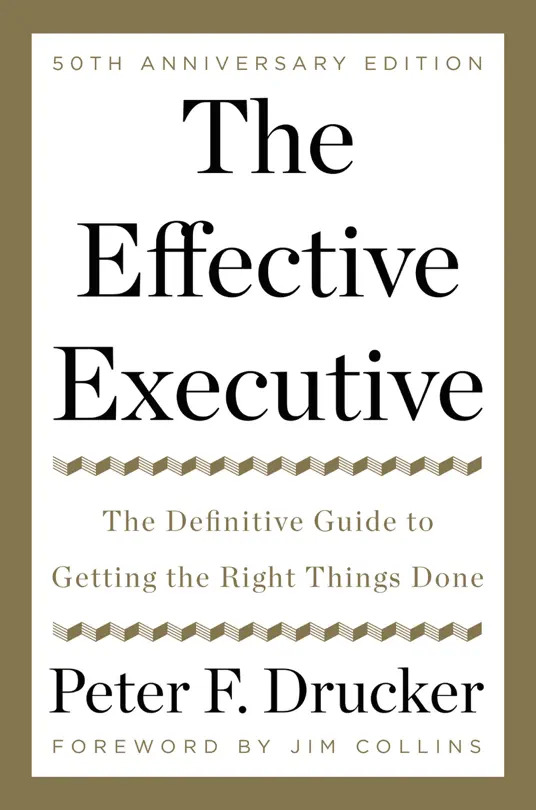
Foreword: to the 50th Anniversary Edition of The Effective Executive
Lessons learned from Peter Drucker: anyone who has responsibility for getting the right things done – anyone who seeks how best to self-deploy on the few priorities that will make the biggest impact – is an executive.
Preface
Management books usually deal with managing other people. The subject of this book is managing oneself for effectiveness. That one can truly manage other people is by no means adequately proven.
One does not come across a single “natural”: an executive who was born effective. All the effective ones have had to learn to be effective. And all of them then had to practice effectiveness until it became a habbit.
What makes an effective executive?
People are usually not stereotypical leaders. They are all over the map in terms of their personalities, attitudes, values, strengths, and weaknesses. They range from extroverted to nearly reclusive, from easygoing to controlling, from generous to parsimonious.
What made them all effective is that they followed the same eight practices:
* they asked, “What needs to be done?”
* they asked, “What is right for the enterprise?”
* they developed action plans
* they took responsibility for decisions
* they took responsibility for communicating
* they were focused on opportunities rather than problems
* they ran productive meetings
* they thought and said “we” rather than “I”
The first two practices gave them the knowledge they needed. The next four helped them convert this knowledge into effective action. The last two ensured that the whole organization felt responsible and accountable.
Without an action plan, the executive becomes a prisoner of events. And without check-ins to reexamine the plan as events unfold, the executive has no way of knowing which events really matter and which are only noise.
Take responsibility for decisions: a decision has not been made until people know:
* the name of the person accountable for carrying it out
* the deadline
* the names of people who will be affected by the decision and therefore have to know about, understand, and approve it – or at least not be strongly opposed to it; and
* the names of the people who have to be informed of the decision, even if they are not directly affected by it
At the beginning of a formal meeting, Sloan announced the purpose of the meeting. He then listened. He never took notes and he rarely spoke except to clarify a confusing point. At the end, he summed up, thanked the participants, and left. Then he immediately wrote a short memo addressed to one attendee of the meeting. In that note, he summarized the discussion and its conclusions and spelled out any work assignment decided upon in the meeting (including a decision to hold another meeting on the subject or to study an issue). He specified the deadline and the executive who was to be accountable for the assignment. He sent a copy of the memo to everyone who’d been present at the meeting.
Why we need effective executives
For manual work, we need only efficiency; that is, the ability to do things right rather than the ability to get the right things done. The manual worker can always be judged in terms of the quantity and quality of a definable and discrete output, such as a pair of shoes. We have learned how to measure efficiency and how to define quality in manual work during the last hundred years – to the point where we have been able to multiply the output of the individual worker tremendously.
Working on the right things is what makes knowledge work effectively. This is not capable of being measured by any of the yardsticks for manual wok.
The knowledge worker cannot be supervised closely or in detail. He can only be helped. But he must direct himself, and he must direct himself toward performance and contribution, that is, toward effectiveness.
One can indeed never be sure what the knowledge worker things – and yet thinking is his specific work; it is his “doing”. He produces knowledge, ideas, and information. By themselves these “products” are useless. Somebody else, another man of knowledge, has to take them as his input and convert them into his output before they have any reality. The greatest wisdom not applied to action and behavior is meaningless data.
Executive realities:
* the executive’s time tends to belong to everybody else. If one attempted to define an “executive” operationally (that is, through his activities) one would have to define him as captive of the organization.
* executives are forced to keep on “operating” unless they take positive action to change the reality in which they live and work.
* the third reality pushing the executive toward ineffectiveness is that he is within an organization. This means that he is effective only if and when other people make us of what he contributes. Organization is a means of multiplying the strength of an individual. It takes his knowledge and uses it as the resource, the motivation, and the vision of other knowledge workers. Unless the executive can reach these people, can make his contribution effective for them an din their work, he has no effectiveness at all.
* finally, the executive is within an organization. The organization – as close and immediate reality. He sees the outside only through thick and distorting lenses, if at all.
The promise of effectiveness
A senior executive, we are told, should have extraordinary abilities as an analyst and as a decision-maker. He should be good at working with people and at understanding organization and power relations, be good at mathematics, and have artistic insights and creative genius has always been in scarce supply. The experience of the human race indicates strongly that the only person in abundant supply is the universal incompetent. We will therefore have to staff our organizations with people who at best excel in one of these abilities. And then they are more than likely to lack any but the modest endowment in the others.
Effectiveness, in other words, is a habit; that is, a complex of practices. And practices can always be learned. These are essentially five such practices – five such habits of the mind that have to be acquired to be an effective executive:
1. effective executives know where their time goes. They work systematically at managing the little of their time that can be brought under their control.
2. effective executives focus on outward contribution. They gear their efforts to results rather than to work. They start out with the question, “What results are expected of me?” rather than with the work to be done, let alone with its techniques and tools.
3. effective executives build on strengths – their own strengths, the strengths of their superiors, colleagues, and subordinates; and on the strengths in the situation, that is, on what they can do. They do not build on weakness. They do not start out with the things they cannot do.
4. effective executives concentrate on the few major areas where superior performance will produce outstanding results. They force themselves to set priorities and stay with their priority results. They force themselves to set priorities and stay with their priority decisions. They know that they have no choice but to do first things first – and second things not at all. The alternative is to get nothing done.
5. effective executives, finally, make effective decisions. They know that this is, above all, a matter of system – of the right steps in the right sequence. They know that an effective decision is always a judgment based on “dissenting opinions” rather than on “consensus on the facts”. And they know that to make may decisions fast means to make the wrong decisions. What is needed are few, but fundamental, decisions. What is needed is the right strategy rather than razzle-dazzle tactics.
2 Know Thy Time
Effective executives, do not start with their tasks, they start with their time. And they do not start with planning. They start by finding out where their time actually goes. Then they attempt to manage their time and to cut back unproductive demands on their time. Finally they consolidate their “discretionary” time into the largest possible continuing units.
One has to find the nonproductive, time-wasting activities and get rid of them if one possibly can.
- First one tries to identify and eliminate the things that need not be done at all, the things that are purely a waste of time without any results whatever. To find these time-wasters, one asks of all activities in the time records: “What would happen if this were not done at all?” And if the answer is “Nothing would happen”, then obviously the conclusion is to stop doing it.
- The next question is: “Which of the activities on my time log could be done by somebody else just as well, if not better?”
- A common cause of time waste is largely under the executive’s control and can be eliminated by him. This is the time of others he himself wastes.
3 What Can I Contribute?
The person who focuses on efforts and who stresses his downward authority is a subordinate no matter how exalted his title and rank. But the person who focuses on contribution and who takes responsibility for results, no matter how junior is the most literal sense of the phrase, “top management”. He holds himself accountable for the performance of the whole.
Knowledge workers do not produce a “thing”. They produce ideas, information, concepts. Output has to be put together with the output of the specialists before it can produce results.
The person of knowledge has always been expected to take responsibility for being understood. It is barbarian arrogance to assume that the layman can or should make the effort to understand him, and that it is enough if the person of knowledge talks to a handful of fellow experts who are his peers. Even in the university orin the research laboratory, this attitude – alas, only too common today – condemns the expert to uselessness and converts his knowledge from learning into pedantry. If a person wants to be considered responsible for his contribution – he has to concern himself with the usability of his “product” – that is, his knowledge.
4 Making Strength Productive
The area in which the executive first encounters the challenge of strength is in staffing. The effective executive fills positions and promotes on the basis of what a man can do. He does not make staffing decisions to minimize but to maximize strength.
Whoever tries to place a man or staff an organization to avoid weakness will end up at best with mediocrity. The idea that there are “well-rounded” people, people who have only strengths and no weaknesses (whether the term used is the “whole man”, the “mature personality”, the “well-adjusted personality”, or the “generalist”) is a prescription for mediocrity if not for incompetence.
The main reason is that the immediate task of the executive is not to place a man; it is to fill a job. The tendency is therefore to start out with the job as being a part of the order of nature.
To structure a job to a person is almost certain to result in the end in greater discrepancy between the demands of the job and the available talent. It results in a dozen people being uprooted and pushed around in order to accommodate one.
But there is a subtler reason for insistence on impersonal, objective jobs. It is the only way to provide the organization with the human diversity it needs. It is the only way to tolerate – indeed to encourage – differences in temperament and personality in an organisation. To tolerate diversity, relationships must be task-focused rather than personality-focused. Achievement must be measured against objective criteria of contribution and performance. This is possible, however, only if jobs ar redefined and structured impersonally. Otherwise the accent will be on “who is right?” rather than on “what is right?”. In no time, personnel decision will be made on “do I like this fellow?” or “will he be acceptable?” rather than by asking “is he the man most likely to do an outstanding job?”
Structuring jobs to fit personality is almost certain to lead to favoritism and conformity. And no organization can afford either. It needs equity and impersonal fairness in its personnel decisions. Or else it will either lose its good people or destroy their incentive.
One implication is that the men who build first-class executive teams are not usually close to their immediate colleagues and subordinates. Picking people for what they can do rather than on personal likes or dislikes, they seek performance, not conformance. To ensure this outcome, they keep a distance between themselves and their close colleagues.
How then do effective executives staff for strength without stumbling into the opposite trap of building jobs to suit personality? The rules simple: any job that has defeated two or three men in succession even though each had performed well in his previous assignments, must be assumed unfit for human beings. It must be redesigned.
The effective executive therefore first makes sure that the job is well designed. And if experience tell him otherwise, he does not hunt for genius to do the impossible. He redesigns the job.
The second rule of staffing from strength is to make each job demanding and big. It should have a challenge to bring out whatever strength a man may have. It should have scope so that any strength that is relevant to the task can produce significant results.
There are fairly reliable tests for the aptitudes and skills needed in manual work. One can test in advance whether a man is likely to do well as a carpenter or as a machinist. There is no such test appropriate to knowledge work. What is needed in knowledge work is not this or that particular skill, but a configuration, and this will be revealed only by the test of performance. A carpenter’s or a machinist’s job is defined by the craft and varies little from one shop to another. But for the ability of a knowledge worker to contribute in an organization, the values and the goals of the organization are at least as important as his own professional knowledge and skills. A young man who has the right strength for one organization may be a total misfit in another, which from the outside looks just the same.
Effective executives know that they have to start with what a man can do rather than with what a job requires. This, however, means that they do their thinking about people long before the decision on filling a job has to be made, and independently of it. This is the reason for the wide adoption of appraisal procedures today, in which people, especially those in knowledge work, are regularly judged. The purpose is to arrive at an appraisal of a man before one has to decide whether he is the right person to fill a bigger position.
The effective executive knows that to get strength one has to put up with weaknesses.
If the need is for the ability to command in a perilous situation, one has to accept a Disraeli or a Franklin D. Roosevelt and not worry too much about their lack of humility. There are indeed no great men to their valets. But the laugh is on the valet. He sees, inevitably, all the traits that are not relevant, all the traits that have nothing to do with the specific task for which a man has been called on the stage of history.
As a rule, two mediocrities achieve even less than one mediocrity – they just get in each other’s way.
“What can this man do?” was his constant question. And if a man could do something, his lacks became secondary. Marshall was only concerned with weaknesses when they limited the full development of a man’s strength. These he tried to overcome through work and career opportunities. Finally Marshall know – and everyone can learn it from him – that every people-decision is a gamble. By basing it on what a man can do, it becomes at least a rational gamble.
But how do I manage my boss? It is actually remarkably easy – but only effective executives know that. The secret is that effective executives make the strengths of the boss productive. The effective executive knows that the boss, being human, has his own ways of being effective. He looks for these ways. They may be only manners and habits, but they are facts.
5 First Things First
If there is any one “secret” of effectiveness, it is concentration. Effective executives do first things first and they do one thing at a time. The need to concentrate is grounded both in the nature of the executive job and in the nature of man. Several reasons for this should already be apparent: there are always more important contributions to be made than there is time available to make them.
We rightly consider keeping many balls in the air a circus stunt. Yet even the juggler does it only for ten minutes or so. If he were to try doing it longer, he would soon drop all the balls. People do, of course, differ. Some do their best work when doing two tasks in parallel at the same time, thus providing a change of pace.
Concentration is necessary precisely because the executive faces so many tasks clamoring to be done. For doing one thing at the time means doing it fast. The more one can concentrate time, effort, and resources, the greater the number and diversity of tasks one can actually perform.
An organization needs to bring in fresh points of view fairly often. If it only promotes from within it soon becomes inbread and eventually sterile. But if at all possible, ones does not bring in the new-comers where the risk is exorbitant – that is, into the top executive positions or into the leadership of an important new activity. One brings them in just below the top and into an activity that is already defined and reasonably well understood.
Priorities and posteriorities: there are always more productive tasks for tomorrow than there is time to do them and more opportunities than there are capable people to take care of them – not to mention the always abundant problems and crises. A decision therefore has to be made as to which tasks deserve priority and which are of less importance. The only question is which will make the decision – the executive or the pressures. But somehow the tasks will be adjusted to the available time and the opportunities will become available only to the extent to which capable people are around to take charge of them.
A good many studies of research scientists have shown that achievement (at least below the genius level of Einstein, a Neils Bohr, or a Max Planck) depends less on ability in doing research than on the courage to go after opportunity. Those reasech scientists who pick their projects according to the greatest likelihood of quick success rather than according to the challenge of the problem are unlikely to achieve distinction. They may turn out a great many footnotes, but neither a law of physics nor a new concept is likely to be named after them. Achievement goes to the people who pick their research priorities by the opportunity and who consider other criteria only as qualifiers rather than as determinants. Similarly, in business the successful companies are not those that work at developing new products for their existing line but those that aim at innovating new technologies or new businesses.
Concentration – that is, the courage to impose on time and events his own decision as to what really matters and comes first – is the executive’s only hope of becoming the master of time and events instead of their whipping boy.
6 The Elements of Decision-Making
Decision-making is only one of the tasks of an executive. It usually takes a small fraction of his time. But to make decisions in the specific executive task. Decision-making therefore deserves special treatment in a discussion of the effective executive. Only executives make decisions. Indeed, to be expected – by virtue of position or knowledge – to make decisions that have significant impact on the entire organization, its performance, and results defines the executive. Effective executives, therefore, make effective decisions.
They know that the most time-consuming step in the process is not making the decision but putting it into effect. Unless a decision has “degenerated into work” it is not a decision; it is at best a good intention. This means that, while the effective decision itself is based on the highest level of conceptual understanding, the action to carry it out should be as close as possible to the working level and as simple as possible.
These are the elements of the effective decision process:
1. the first question the effective decision-makers asks is: “is this a generic situation or an exception?” “is this something that underlies a great many occurrences?” Or is the occurrence a unique event that needs to be dealt with as such?” The generic always has to be answered through a rule, a principle. The exceptional can only be handled as such as it comes.
2. the second major element in the decision process is clear specifications as to what the decision has to accomplish. What are the objectives the decision has to reach? What are the minimum goals has to attain? What are the conditions it has to satisfy? In science these are known as “boundary conditions”. A decision, to be effective, neds to satisfy the boundary conditions. It needs to be adequate to its purpose.
But clear thinking about the boundary conditions is needed also to identify the most dangerous of all possible decisions: the one that might – just might – work if nothing whatever goes wrong. These decisions always seem to make sense. But when one thinks through the specifications they have to satisfy, one always finds that they are essentially incompatible with each other. That such a decision might succeed is not impossible – it is merely grossly improbable. The trouble with miracles is not, after all, that they happen rarely; it is that one cannot rely on them.
3. One has to start out with what is right rather than what is acceptable (let alone who is right) precisely because one always has to compromise in the end. But if one does not know what is right to satisfy the specifications and boundary conditions, one cannot distinguish between the right compromise and the wrong compromise – and will end up making the wrong compromise.
4. Converting the decision into action is the fourth major element in the decision process. While thinking through the boundary conditions is the most difficult step in decision-making, converting the decision into effective action is usually the most time-consuming one. Yet a decision will not become effective unless the action commitments have been built into the decision from the start. In fact, no decision has been made unless carrying it out in specific stpes has become someone’s work assignment and responsibility. Until then, there are only good intentions.
A story that has become a legend among operations researchers illustrates the importance of the question “Who has to know?” A major manufacturer of industrial equipment decided several years ago to discontinue one model. For years it had been standard equipment on a line of machine tools, many of which were still in use. It was decided, therefore, to sell the model to the present owners of the old equipment for another three years as a replacement, and then to stop making and selling it. Orders for this particular model had been going for a good many years. But hey shot up as former customers reordered against the day when the model would no longer be available. No one had, however, asked, “Who needs to know of this decision?” Therefore nobody informed the clerk in the purchasing department who was in charge of buying the parts from which the model itself was being assembled. His instructions were to buy parts in a given ratio to current sales – and the instructions remained unchanged. When the time came to discontinue further production of the model, the company had in its warehouse enough parts for another eight to ten years of production, parts that had to written of at a considerable loss.
5. finally, a feedback has to be built into the decision to provide a continuous testing, against actual events, of the expectations that underlie the decision. Decisoins are made by men. Men are fallible; at their best works do not last long. Even the best decision has a high probability of being wrong. Even the most effective one eventually becomes obsolete.
7 Effective Decisoins
A decision is a judgment. It is a choice between alternatives. It is rarely a choice between right and wrong. It is at best a choice between “almost right” and “probably wrong” – but much more often a choice between two courses of action neither of which is provably more nearly right than the other.
Most books on decision-making tell the reader: “First find the facts”. But executives who make effective decisions know that one does not start with the facts. One starts with opinions. These are, of course, nothing but untested hypotheses and, as such, worthless unless tested against reality. To determine what is a fact requires first a decision on the criteria of relevance, especially on the appropriate measurement. This is the hinge of the effective decision, and usually its most controversial aspect
To get the facts first is impossible. There are no facts unless one has a criterion of relevance. Events by themselves are not facts. In physics the taste of a substance is not a fact. Nor, until fairly recently, was its color. In cooking, the taste is a fact of supreme importance, and in painting, the color matters. Physics, cooking, and painting consider different things as relevant and therefore consider different things to be facts.
The only rigorous method, the only one that enables us to test an opinion against reality, is based on the clear recognition that opinions come first – and that this is the way it should be. Then no one can fail to see that we start out with untested hypotheses – in decision-making as in science the only starting point. We know what to do with hypotheses – one does not argues them; one tests them. One finds out which hypotheses are tenable, and therefore worthy of serious consideration, and which are eliminated by the first test against observable experience.
The effective executive encourages opinions. But he insists that the people who voie them also think through what is that the “experiment” – that is, the testing of the opinion against reality – would have to show. The effective executive, therefore, asks: “What do we have to know to test the validity of this hypothesis?” “What would the facts have to be to make this opinion tenable?” And he makes it a habit – in himself and in the people with whom he works – to think through and spell out what needs to be looked at, studied, and tested. He insists that people who voice an opinion also take responsibility for defining what factual findings can be expected and should be looked for.
The effective decision-maker assumes that the traditional measurement is not the right measurement. Otherwise, there would generally be no need for a decision; a simple adjustment would do. The traditional measurement reflects yesterday’s decision. That there is need for a new one normally indicates that the measurement is no longer relevant.
Decisions of the kind the executive has to make are not made well by acclamation. They are made well only if based on the clash of conflicting views, the dialogue between different points of view, the choice between different judgments. The first rule in decision-making is that one does not make a decision unless there is disagreement.
A decision without an alternative is a desperate gambler’s throw, no matter how carefully thought through it might be. There is always a high possibility that the decision will prove wrong – either because it was wrong to begin with or because a change in circumstances makes it wrong.
Like any reasonably experienced adult, he has learned to pay attention to what Socrates called his “daemon”: the inner voice, somewhere in the bowels, that whispers, “Take care”. Just because something is difficult, disagreeable, or frightening is no reason for not doing it if it is right. But one holds back – if only for a moment – if one finds oneself uneasy, perturbed, bothered without quite knowing why. But the effective decision-makes does not wait long – a few days, at the most a few weeks. If the “daemon” has not spoken by then, he acts with speed and energy whether he likes to or not. Executives are not paid for doing things they like to do. They are paid for getting the right things done – most of all in their specific task, the making of effective decisions.
Decision-Making and the Computer: the computer is a potent tool of the executive. Like hammer or pliers – but unlike wheel or saw – it cannot do anything man cannot do. But it can do one human job – addition and subtraction – infinitely faster than man can do it. And, being a tool, it does not get bored, does not get tired, does not charge overtime. Like all tools that do better something man can do, the computer multiplies man’s capacity (the other tools, such as the wheel, the airplane, or the television set that do something man cannot do at all, add a new dimension to man, i.e., extend his nature).
 alin miu