
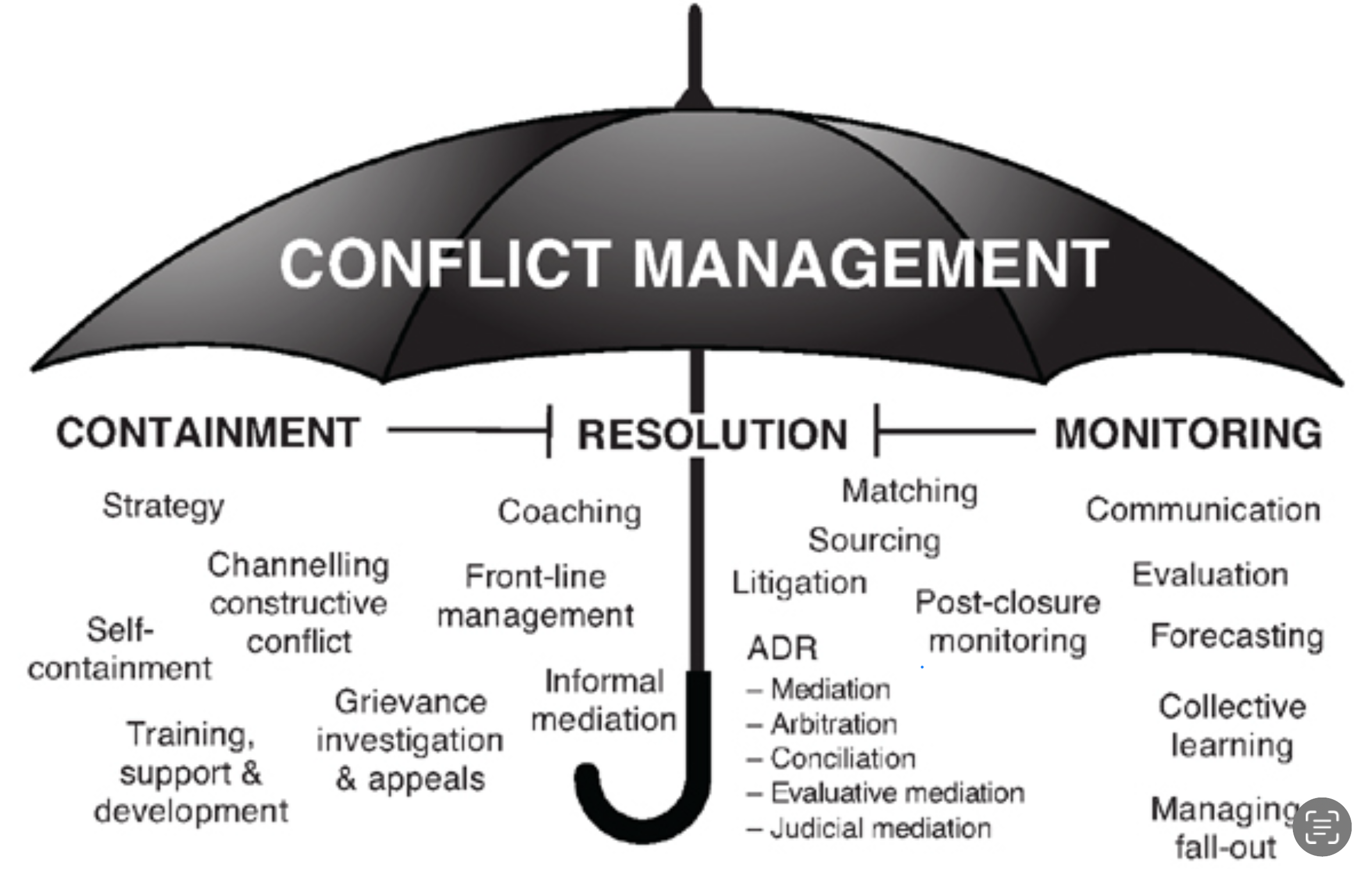
Managing conflict is broader than what most people understand as ‘mediation’, which we might paraphrase as: ‘an intervention between disagreeing parties involving a third party, aimed at bringing the dispute to a conclusion that both can accept’. It is a responsibility that needs to be shared by the whole management team of any organization as much as with those who might often be though of as ‘the conflict specialists’:
- front-line managers can play a vital role in recognizing the early stages of potential unproductive conflict, step in and stop many disputes from developing further, as well as helping to minimize or prevent conflict from happening in the first place
- HR managers are often the first point of contact for escalated disputes, though members of the HR team (as well as other managers with the right personal qualities, will and proper training) can play the role of mediator in formal disputes
- leaders have a key role to play in modelling desired behaviours, ensuring that conflict management strategy is given prominence and adequate resourcing, and in supporting a drive toward building a ‘happy company’
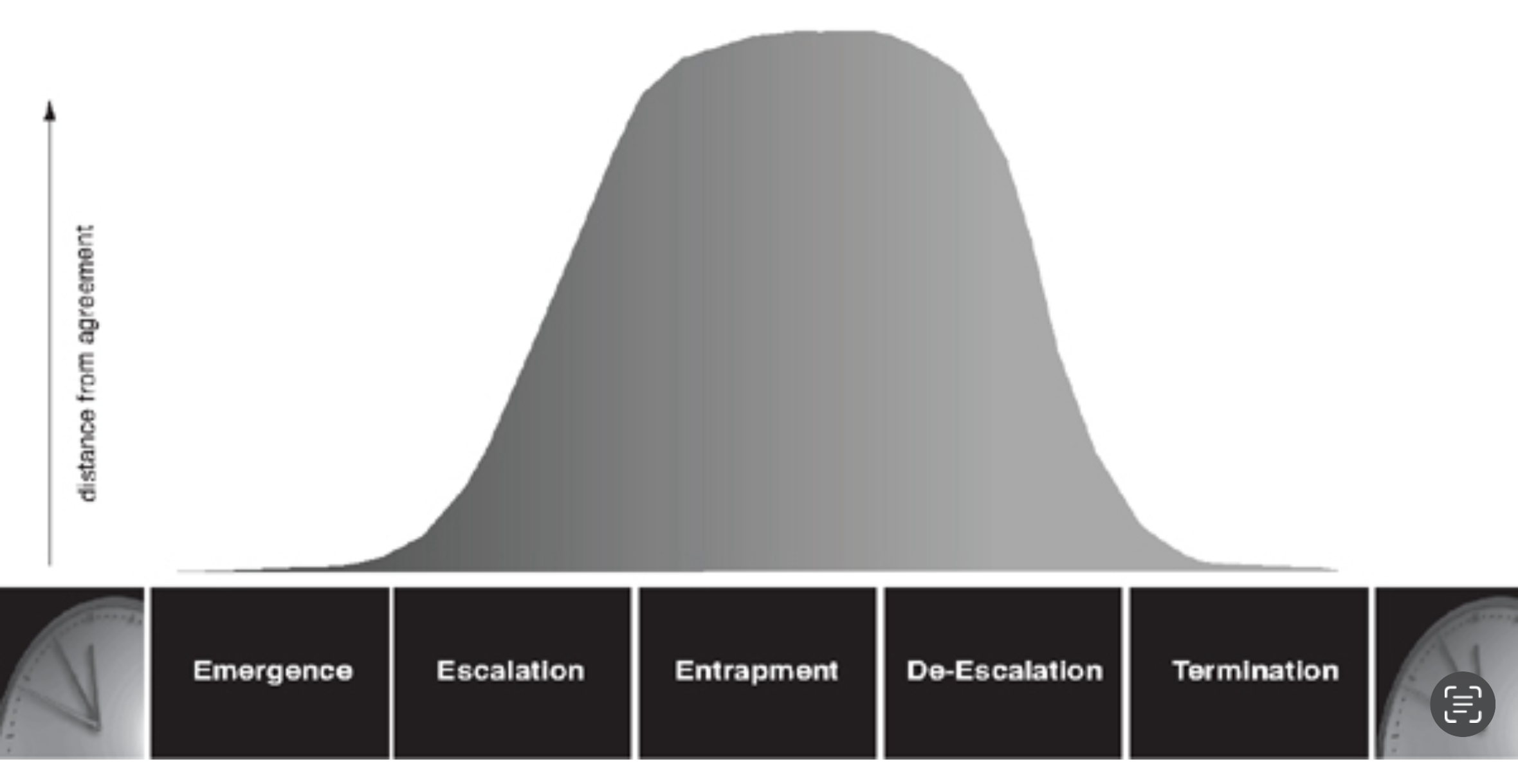
The conflict lifecycle
- emergence
- escalation
- entrapment
- de-escalation
- termination
Models for Approaching Conflict Management
The Thomas-Kilmann Conflict Mode Instrument (TKI) (Thomas and Kilmann, 1974-2009) is perhaps the best-known model used in workspace dispute resolution. This distinguishes five styles for working with conflict, set out according to whether an individual is ready to cooperate in a dispute resolution process and their tendency to be passive or assertive:
- Competing – strongly assertive and not inclined to cooperation, an individual whose natural style is ‘competing’ is likely to be uncompromising, a poor or reluctant listener, single-minded and aggressive
- Collaborating – a collaborator will not be shy to express his or her views, but be far more ready than someone whose usual style is competing to consider the perspectives of others
- Accommodating – displayed by passive individuals who are also ready to compromise
- Avoiding – typical of those who put off facing a problem
- Compromising – shown by those who differ in their readiness to cooperate and who may be active or passive at different times or when facing different circumstances
Introducing ‘RESOLVE’
The model adopts the rather appropriate mnemonic ‘RESOLVE’, which incorporates the following elements:
R – review, rules, and roles: The ‘3 Rs’ cover the ongoing task of reviewing what is said to establish answers, setting and referring to ground rules when appropriate, and making clear the role of mediation and mediator
Review – this ensures that both parties are given reasonable space to put their point of view across. It may help either party better understand what is at the root of their dispute, by having an opportunity to think about and with some degree of expectation to clearly articulate what is causing their concern, or by having the main substance of the other party’s viewpoint. When used during the opening of a joint session, review might be considered to be the equivalent of an exchange of opening statements in a court trial – though we don’t want to push this analogy too far. By allowing each party an opportunity to introduce their perspective in a structured and controlled way, discussion can then quickly move on to identifying common objectives for mediation and, in turn, the ground rules that should guide discussion. Quite often this alone is sufficient to open the door to an effective solution.
Rules – ground rules need to be agreed between the parties who are locked in a dispute to ensure that mediation flows effectively. Ideally, the rules should normally be proposed by the individuals themselves; however, one party may object to proposals put by the other. A mediator may therefore need to be ready to propose possible principles that both parties might wish to consider, for example:
– respecting each party’s right to speak;
– having a irrefutable presumption that both parties want to reach a satisfactory outcome;
– recognizing when discussion is diverting from matters that may be most relevant or are not helping each party to move forward;
– respecting the role of the mediator as an impartial intermediary whose aim is to support the best outcome for both parties
Roles – making clear the roles of mediation and mediator are at the outset is intended to avoid possible misunderstanding by one or both parties. A possible way for a mediator to set the scene might run on the lies of: “This has been discussed with you privately; the reason we are here today is to work towards achieving a resolution. My role in this process is to help guide this discussion, and I would like to offer you my assurance that my role is to help facilitate your discussion.
The following might feature as boundaries for mediation:
– not offering direct advice (except in certain circumstances or where the form of mediation requires this, eg in evaluative mediation);
– not acting as judge (except when acting as arbitrator);
– not offering personal opinions
For example, a line manager who is attempting to defuse an apparent disagreement between two members of a team might label the boundaries of their role, such as, “I’m not here to say who is right or wrong, but to help you move forward to a realistic outcome’ or, ‘I want to help you appreciate why [the other party] sees things the way they do.’
E – emotions – acknowledges the fact that there are emotions involved at the outset and points out that it’s often unproductive to allow these to encroach when searching for a mutually agreeable outcome
RESOLVE stresses that it’s important to acknowledge emotions – the physiological and mental states we all consciously experience as feelings, moods or impulses and associate with attitudes or states of mind.
Strong emotion is a major ingredient in the mix that drives individuals into a dispute. One or more of the ‘primary emotions’ may be at work – happiness, sadness, fear, anger, surprise and disgust; but so too may less obvious ones, such as jealousy, guilt and pride. What’s more, it may not be clear even to the individuals themselves what emotions they are feeling.
S – summarize: mediators need to routinely summarize what they’ve heard to ensure they have a thorough understanding of all the relevant points in the issue. Both parties can correct the summary so that the final summary is satisfactory to both sides.
– help clarify understanding -both for the mediator and for individual parties. Testing to ensure that they’ve built up an accurate understanding of what has been said is especially important when a mediator believes it’s time to suggest moving the conversation to another point. Left unchecked misinterpreted comments can have a bad habit of unsettling attempts to reach an agreement later.
– help signpost a dialogue, using the opportunity to state not only what has been achieved but the point the discussion has reached on any route map that may have been proposed earlier, and linking into the next topic of discussion.
– help isolate common ground between the parties, points that have been agreed or other areas where progress has been made in discussion (this may be especially helpful where the perception of what progress has been achieved by those in the room is limited or where a complex topic needs to be broken down into its constituent parts).
‘Reverse summaries’ may also be used, inviting one or both parties to state what stagetegy believe the dialogue has reached. For example, a mediator might ask, ‘Please would you like to summarize where we are?’
O – outcome: agrees a mutually acceptable outcome, identifying the existing common ground on both sides as a starting point for finding a suitable ending
It may be an obvious point, but both parties must want to achieve an outcome for any attempt at a resolution to succeed. Without having a clear view of the outcome each party wants from mediation, it’s very difficult for anyone to know when a successful conclusion to the process has been reached. The value in considering outcomes is therefore to both define and remind individuals of what it is they are seeking to achieve as the discussion progresses.
Perhaps the most useful tool for encouraging individuals to describe what they want to achieve is simply to ask them to imagine what their situation will look like following mediation.
Guideline for considering an outcome is to ensure that it fits with the ‘3Ms’ – that it’s motivating, manageable and measurable (the concept of the ‘3Ms’ is credited to Julie Hay(Hay, 2007)).
L – learning: learning from the experience of a dispute can be gained for all parties involved, not to mention helping to inform changes individuals and the organization as a whole can make to enhance preventive conflict management and improve the effectiveness of dispute resolution in the future. So too, learning and insights gained for individuals as the penny drops during the resolution of their particular dispute shouldn’t be allowed to get lost after further discussion.
V – value: once the outcome has been agreed upon, a mediator should thank and affirm all those involved for their efforts, emphasizing what they’ve achieved.
To value or express appreciation for each individual’s contribution takes no more than a moment, but it can be very powerful in affirming the achievement that have been made.
E – engage: invites all parties to engage with each other to continue going forward in a positive way and to help prevent similar occurrences in the future.
Engaging refers to the task of inviting participants to take part actively in mediation and also to committing to carrying forward any decisions or action that they agree. Engaging goes beyond just motivating individuals to utter the words they think you want to hear to inspire action.
RESOLVE provides a simple model to use in dispute resolution, considering the past perspectives that have brought individuals into a dispute and focusing on the outcomes that they wish to achieve. It may be used at virtually any stage during the development of a dispute, including the ‘Golden Hour’ opportunity for early, informal mediation.
RESOLVE offers a reminder that dispute resolution usually provides an opportunity for defining a new beginning for the disputing parties, and hence the model recalls the ‘Janus perspective’, or the perspective offered by the Roman god of new beginnings.
Preventing conflict
The original trigger for a dispute may often appear to be quite mundane. However, it’s when individuals’ positions become entrenched and a game of bat-and-ball begins between two increasingly diametrically opposed parties that the task of reaching a quick and easy resolution becomes challenging. Time is usually of essence: a front-line manager needs to be able to recognize when a unhelpful dispute is brewing and to intervene quickly in a helpful way. This is what we call the ‘Golden Hour’ (we’ve devoted a section later on to consider how to identify and optimize the opportunity offered during this critical period). Managers need to be equipped to deal with emerging conflicts, requiring both finely honed interpersonal skills and a range of techniques to confront the unexpected (what we call ‘micro-tools’).
Communication styles and manager choices
Managers, as much as anyone else, can choose from a variety of ways of communicating with another individual. When imparting information, a choice may be made between being directive, stating a clear view or instruction; or participative, inviting suggestions and comment from the other person. A directive or ‘tell’ instruction doesn’t need to be made curtly, as though issuing an order. For example, the command, ‘You’ll finish your report by Monday’ might better be framed as: ‘I need your report by Monday so that I’ll be able to finish the briefing note for Tuesday’s board meeting.’
Making a demand without an explanation can be interpreted as an unreasonable order, lacking two-way respect. Compare the impacts of the statements: ‘I feel disappointed because you said you would finish it and you didn’t’, with ‘When you said you’d finish it and didn’t, I felt disappointed because I want to be able to count on you’, or ‘Have I given you everything you need to know?’, and ‘Is there anything else you might need from me?’
Similarly, managers can choose whether or not to be participative in listening to what others have to say. They may keep an open mind, genuinely consider the points raised by thinking. Alternatively, they may remain resolute in their views and, consciously or otherwise, filter out anything that contradicts this or which they don’t want to hear: listening to instruct rather than listening to engage.
Potential breakpoints between ‘sender’ and ‘receiver’
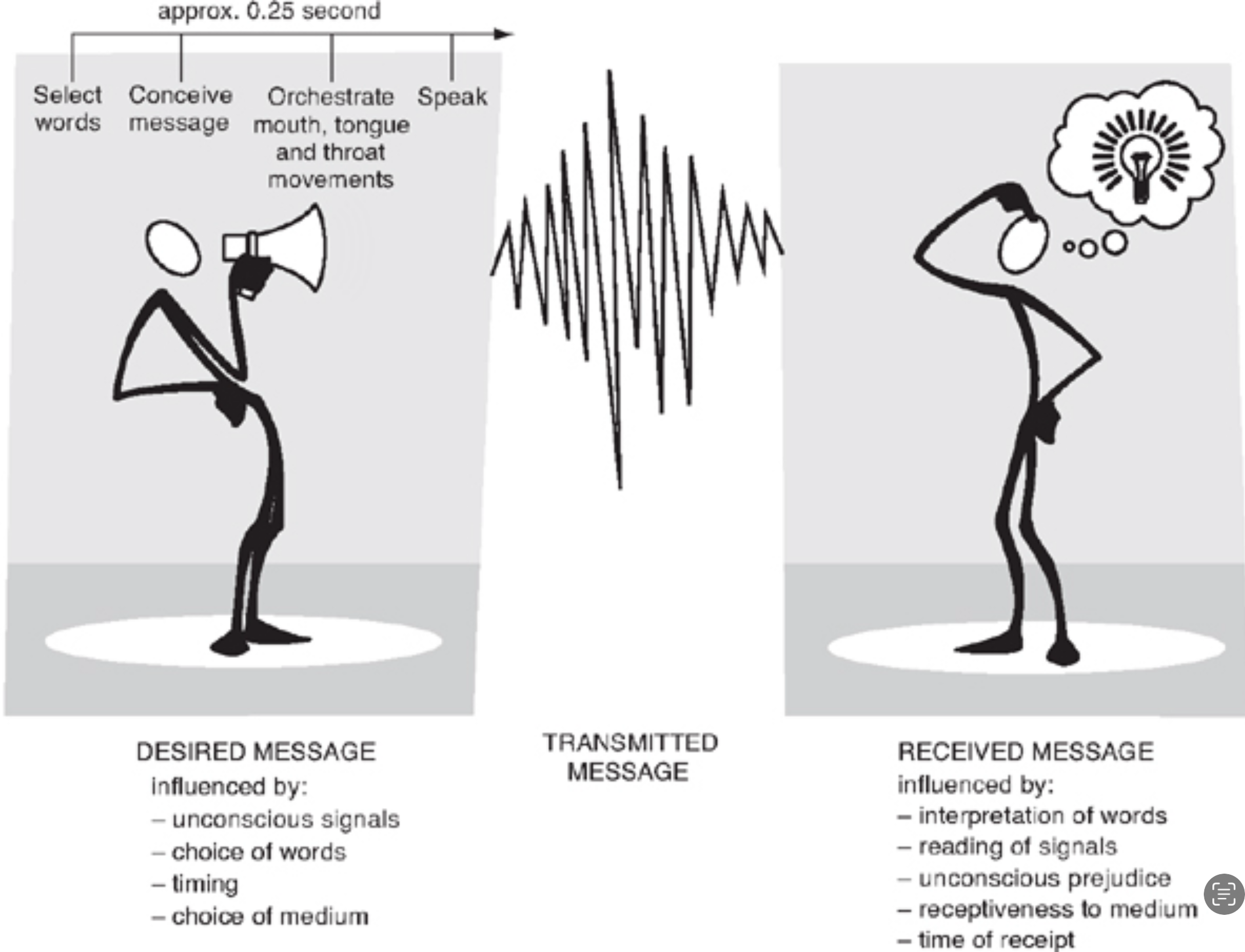
Unfortunately, expediency, or defaulting to a preferred communication style, is normally the master when communicating at the moment, although applied practice can break this natural instinct. What’s more, many managers are hesitant about using communication styles they aren’t familiar with, especially if they perceive that these may undermine their position of power within a team.
Much has been written on management style, though perhaps one of the most useful models for our purposes comes from the well-known ‘situational leadership’ theory developed by Paul Hersey and Ken Blanchard (Hersey and Blanchard, 2008). This describes four main leadership styles (or behaviors):
- Directive/Tell: defining roles, setting tasks, supervising closely
- Coach/Sell: defining roles and tasks, but also inviting input
- Supportive/Participative: delegating a degree of decision making, whilst supporting, observing and being ready to intervene when appropriate
- Delegate: passing on greater discretion for decision-making and task management, largely leaving the individual to seek advice/guidance when he or she feels a need for it.
Which style should be used, the model suggests, depends on the performance development level of the person being managed, one of being:
- unable and insecure or unwilling: the individual lacks both the ability to decide how to approach a task and the motivation or confidence to do so.
- unable but confident or willing: as above, but where the team member has confidence or motivation.
- able but insecure or unwilling: confidence may be lacking, motivation may be poor, although the individual has the competency to see through the task.
- able, confident and willing: the best of all worlds – the individual shows positive levels of motivation, confidence and ability.
The key to being an effective situational leader isn’t just knowing which style to adopt to suit the circumstance, but being sufficiently adaptable to skip from one style into another.
Management styles
| Counsellor ‘You do it; I’ll be a reflecting board’ | Coach ‘What do you want to achieve?’ ‘How will you achieve this?’ ‘What will you do?’ ‘How committed are you to seeing this through?’ |
| Facilitator ‘You make the decisions; I’ll help smooth the process’ ‘Is there anything I can do that would make it easier for you to explain this?’ ‘Is the approach we’re taking helping?’ ‘What do you think is the best way for getting to the bottom of this?’ | Teacher or Trainer ‘Here are some hints and techniques you can use for this task’ |
| Reflective observer ‘You try; I’ll observe and reflect back what I see’ | Adviser ‘I’ll answer any questions when you hit a problem’ |
| Mentor ‘First, tell me what you think. If you wish, I’ll then offer suggestions based on my experience’ | Collaborator or Partner ‘We’ll try this together and learn from each other’ |
| Hands-on expert ‘I’ll do the task; I’ll tell you how to do this’ | Modeller ‘You watch me demonstrate. Learn from me.’ |
It is nearly always necessary to mix interventions; however, the following are most commonly used in managing conflict:
- coaching
- facilitating
- mentoring
- counseling
A manager’s contribution to conflict
There are five main clusters of behavioral and personality types often seen in the management ranks; those who:
- see attention and believe that they are worthy (‘dramatic’);
- are hypersensitive and protective of information (‘suspicious’);
- deliberately isolate themselves from others (‘detached’);
- undervalue themselves and lack confidence (‘depressive’);
- are domineering, dogmatic, lovers of rule and insistent on perfectionism (‘compulsive’)
Hard conversations
Sometimes tough talk just can’t be avoided. It may be that an individual is causing disruption to team stability beyond a point that is acceptable, doesn’t recognize when he or she is crossing a line or, perhaps, is deluded in his or her assessment of their own virtuosity.
Many managers find straight talking with others difficult. By definition, this involves describing things as they are. By being open, honest and direct, a manager may often best help an individual gain awareness of the reality of a situation. But uncomfortable home truths may not be received graciously, especially if an individual is already in a state of heightened anticipation and uncertainty. Tough-talking may easily trigger feelings of insecurity, denial and defensiveness.
Recognition
Being able to recognize the early warning signs of a possible dispute is obviously key to knowing when and how to intervene.
Prevention
Prevention incorporates three elements:
- having a heightened early warning system of potential disputes
- equipping managers or others in the ‘front line’ with the knowledge and skill to broker a swift resolution as soon as a dispute emerges
- limiting the conditions in which conflict is allowed to thrive
Managing conflict from the front line
Responsibility for dispute resolution typically sits with front-line managers during the early stages of a dispute, with dispute resolution specialists being more likely to be called upon in later stages. In considering a manager’s normal main role in resolving conflict it’s therefore useful to understand the perspectives taken by the disputing parties during these early stages.
An emerging dispute
The main aim of a manager who detects hints of unease should be to defuse the situation. This may mean intervening to speak to the individuals concerned, which may take the form of understanding what their concerns are, being explicit in acknowledging why they perceive potential unease, and seeking to correct any false perceptions.
“I know you think you understand what you think I said, but I’m not sure you realize that what you heard is not what I meant!”
Mediation planning checklist
- how much time, how many sessions and what involvement of people may be required
- which venue to use for discussions (eg, using a neutral, quiet and not overlooked room – a challenge in many open plan environments in which conference rooms may be separated from an open office by just a thin pane of glass)
- whether it’s appropriate to commence mediation with opening statements or to assume a clean state
- what ground rules may be appropriate to propose as a basis for guiding the dialogue
- what resources may be useful to have to hand (eg, flipcharts and markers, paper and pens to help individuals with their reflection, and supplies of drinking water)
- whether an open circle seating arrangement is preferable to separating each side across a table
Game strategy
To help determine which game strategy is being used by the disputing parties, the ‘Dual Concern’ model is useful (attributed to Pruitt and Kim, 2004). This identifies four key strategies:
- Competing/contending
- Yielding
- Avoiding
- Problem solving
Which strategy a party is most likely to adopt is suggested to be a function of their concern for achieving their own outcome and the concern they have for the other party reaching a satisfactory result.
In a situation in which a conflict is escalating, a ‘competing’ strategy might be expected. By contrast, a ‘yielding’ or ‘solution-focused’ approach may seek to find a solution that is acceptable to both parties; however, these will have less chance of succeeding if one of the opposing parties continues to pursue a competing or avoiding strategy.
The practice of dispute resolution: critical encounters
Introducing the conflict-busting ‘micro-tool’
For example, in response to someone who announces that they’re ‘really angry’, a simple tool might consist of just a few brief phrases:
‘I’m listening, please go on …’
‘Tell me what has caused you to react like this.’
‘What is it that you want to happen?’
First principles of mediation:
Mondays or the first working day of a week should generally be avoided; conversely, Fridays are often suitable for mediation, ending with a natural weekend break for individuals to follow their experience, in preference to immediately returning to their work environment.
Pride an apology
Another human trait may often stand in the way of breaking tit-for-tat disputes: the great difficulty many of us have in saying ‘sorry’. In most societies and organizations, humility is far less in evidence than politicking or mud throwing. Why is it so hard for many of us to resist the tempatation to fight for what we believe is right?
Mediators may find that they occasionally need to help individuals back off with dignity, and to address the feares they may have; for example for a manager, a sense of losing control; for a subordinate, a fear that they’ve permanently damaged their reputation. A sudden awareness of a mistaken perspective can also be difficult for an individual to handle: in Japan and elsewhere in Asia, ‘saving face’ means a loss of credibility or respect from others. Admitting a mistake involves a measure of humility, but usually also involves finding a strategy for preserving self-dignity and reputation.
Effective conflict management calls on front-line managers to have sharpened skills for spotting the early signs of emerging disputes, know how to contain mounting conflict and be ready to anticipate the various pitfalls that can unseat the unwary, as well as having well developed emotional inteligence.
Mediators who are called upon to intervene in escalated disputes need to be carefully selected, whether externally supplied or grown in an in-house mediators’ pool, whilst their continuing development and supervision need to be properly supported. Mediators should pay attention to managing their own continuing learning, reflecting on their own experiences and those of others.
Conflict management micro-tools
The basics
The seven rules of communictation
- listen (listen, individuals out rather than talk them out)
- empathize
- adopt the appropriate attitude
- be sincere
- respect the dignity of others
- build trust
- show compassion
Five “WH’ questions
- ‘What?’
- ‘Why?’
- ‘Where?’
- “When?’
- ‘Who?’
Socratic questions
‘What lies behind your thinking here?’
‘What alternative explanations might be given for this?’
‘What led you to start from this position?’
‘What would be the rest if…?’
‘How can you be sure about this?’
‘What seems to support your thinking?’
‘How might this stand up in front of a jury?’
‘What attracts you to this line of thinking?’
Direct routes and possible deviations
(Questions that aim to help individuals keep focus and ones that might lead them to stray from finding a resolution)
Direct routes:
‘How did you know that was right?’
‘What might you have done differently?’
‘What have you done before that helped you reach an understanding?’
‘What did you contribute to the situation?’
‘What did you learn from that experience?’
‘How did you do that?’
‘What went well?’
‘What else?’
Possible deviations:
‘Why did you do that?’
‘What should you do next time?’
‘What went wrong?’
‘Is there anything else?’
‘Is there anything you’ve tried before that led you to an answer?’
‘What obstacles will you first need to overcome?’
‘Why don’t you put this into practice?’
‘What’s stopping you?’
Conversation management
JAM – ‘Just a minute’ (or JAMMING – just a micro managerial intervention negation grief. For use in impromptu conversations or when time is limited)
‘What’s happening at the moment?’
‘What do you want to happen?’
‘What’s been working?’
‘What am I impressed with?’ (Give affirmation, eg for the individual raising this)
‘What do you think you need to do now?’
‘What is the first step you’ll take?’
Structured mediation:
- set the scene: ask each individual to give their view of the disagreement
- identify desired outcomes: ask each person to say what they believe will bring the dispute to a satisfactory end
- challenge any unrealistic expectations: suggest that these are weighed against the benefits of achieving an earlier and satisfactory (if not perfect) resolution
- invite and (if appropriate) propose areas of common ground, then break down areas of difference. Give affirmation where thre are areas of agreement.
- invite suggestions about how each individual believes each difference may be resolved, how he or she assesses the practicality of achieving his or her suggestions quickly and highlight common or similar proposals that both can work with
- invite both parties to say whether any of their remaining differences may be met with a compromise or allowed to let lie in the interests of securing a peace. If either party believes that this isn’t possible, question how they wish to make the matter forward, exploring options if appropriate
- summarize agreements, commitments and actions. If appropriate, invite both parties to shake hands, and give encouragement and – very important – affirmation for the progress that has been made. Ask for commitment that any continuing difference will not be allowed to interfere with relationships with others. Ask if the individuals are content with the way the process has been handled and whether general feedback and learning may be passed on to others.
Objective and outcome setting
‘Imagine looking back on this in two years time … What do you think it will look like then?’
‘What do you want to do [gain from this]?’
‘What do you want/need to happen/achieve?’
‘What would be your ideal outcome?’
‘What are your priorities looking forward?’
Confirming ground rules
‘Do you both agree to respect/accept these ground rules?’
Reflecting and summarizing
(Mirroring language used by participants):
‘You said that you would…’ (use exact phraseology).
Re-checking the approach as the dialogue proceeds
‘Are you finding this approach helpful?’ (If the reply is positive, ask: ‘What exactly are you finding useful?’; if negative, ask: ‘What would you find useful?’)
‘What do you think is the best way for getting to the bottom of this?’
‘Can we approach this in another way?’
Breaking sessions
(Teasing out whether both parties want to continue beyond the planned end of a conversation):
‘Is this a good place to end your discussion [today]?’
‘Can you place a mental marker of where you are so you can re-engage [tomorrow]?’
(When individuals may be tiring): ‘Are you able to focus and do justice to this matter right now?’
Requesting feedback as learning for others
‘What helped [been useful]?’
‘Can we share this [learning] with the organization?’
‘Do you have any suggestions about how we might feed this back into the organization?’
Exploring meaning
Gathering information
‘What are you thinking [when…]?’
‘How do you believe this situation arose in the first place?’
‘What’s your view of how the grievance producedure works?’
‘What options have you considered?’
‘WHat have you achieved since we last spoke?’
Where greater clarity is needed on how strongly an individual believes someting, using claing can be very powerful.
Exploring a tought chain or idea
‘What might [the other party] feel like if this were to happen?’
‘What lies behind your thinking?’
Clarifying understanding
(For the questioner and/or the person being questioned):
‘I’m not sure I understand how you believe this explains your disagreement. Can you explain this for me?’
‘[Your views] should help me appreiate your thinking…’
‘I’ve heard you say… Please correct me if I’ve misunderstood’ (use the same phraseology as the person/people being spoken to).
TED-PIE
(Tell Me, Explain to me, Describe to me – Previously, In detail and Exactly):
‘Tell me what has brough you here [to this]…’
‘Explain to me what will be useful [what it is you want to achieve]’, ‘Explain to me how this has come about…’
‘Describe what you are thinking [feeling/experiencing]?’, ‘What if…? Describe how you’d feed in this case…’
‘Previously, before this began, what was going well?’ ‘Previously, how was your working relationship?'(Note to emphasis here is on what was right, not what’s now wrong)
‘On a scale of 1 to 10, how do you feel about [this idea]?’
Channelling emotion
Helping an individual express emotion
‘Did you see [name of person]’s reaction?’
‘I noticed that when you said …, she appeared annoyed/upset.’
Labeling emotion
‘Tell me your grounds for feeling like this?’ (Reflect on the emotion)
‘What’s the strongest feeling you’re experiencing in [the dispute].’
Responding to aggression
‘Please try not to shout. This doesn’t help me.’
‘I know you don’t mean to [attack me]… we all have to let off steam at times; however, I’m feeling quite intimidated.’
Challenging assertions and behavior
Framing challenges
(As invitations rather than as points of view):
‘What are you thinking when…?’ as opposed to, ‘I feel there’s something you’re not saying.’
‘I’ve noticed you have a dry sense of humor. However, I’ve also noticed that not everyone appreciates this. Can you bear this in mind?’ might be better received than, ‘I think your office banter can overstep the mark, and not everyone appreciates it.’
‘How have you reached this conclusion? Can we discuss?’ may be less aggressive than, ‘Didn’t you understand what I wanted?’
Challenging convictions
‘How can you be sure about/know this?’
‘What seems to back up your thinking?’
‘What’s your understanding of this situation? How did you reach this view?’
‘What do you [think you] know?’
‘What evidence is there to suggest otherwise?’
The ‘consequences’ question
‘What would be the consequence of not addressing these issues?’ (This question may serve as a wake-up call for some)
Challenging behavior
‘What stops you doing this?’
‘How would you feel if you were able to say sorry?’
‘What would happen if you said sorry?’
Exploring and reframing perspectives
Considering others’ viewpoints
‘If a group of your colleagues were to listen in on your discussion now, what might they say?’
‘If you were able to observe yourselves speaking at the moment, what observations do you think you might have?’
‘What would an independent observer make of this current situation?’
‘If we were to put this to [the other party], how do you think they might respond?’
Imagine role-play
‘Imagine you’re watching this… What would you be thinking at this point?’
‘How might this stand up in front of a jury?’
Visioning
(Taking a future perspective):
The ’10:10:10′ question: ‘What will this look like in 10 days?… 10 weeks? … 10 months?’ (May help put an issue into perspective)
‘Imagine that you’re working together and your differences have been resolved. What’s the first charge you notice?
What’s happening?… What are the benefits for you?… For others?… For the organization?’
‘If I were to talk to you in six weeks, what would be different when these issues are solved?… What will others notice?’
‘How do you see your relationship in the future?’ ‘What would you be saying/doing/feeling?’
‘What should you stop/start/continue doing?’
Considering alternatives
‘What other ways could you look at/explain this?’
‘What are the possible outcomes?’
‘How might a devil’s advocate respond to this viewpoint?’
Encouraging conversation
Selling the benefits of talking about a concern
‘Would it help to talk to someone who’s not involved in this?’
‘Would it help if we went and found a quiet place for a coffee?’
‘I’m not here to judge.’ (Offers reassurance that to engage is safe)
‘It doesn’t seem to me that you’re making much headway sorting this out alone. Can we talk?’ (Challenging the current situation)
‘Is there anything I can do that would make it easier for you to explain this?’
Negotiation
Identifying tradable concessions
‘What are you prepared to give up [compromise] to achieve this?’
‘What’s it worth to you to achieve this?’
‘How important is this for you [use scaling]?’
‘What’s the best way forward for reaching an agreement?’
Reaching agreement
Confirming each individual is comfortable with proposals made
‘Do we have a common agreement on this?’
‘Is there anything else you want to add, [name of each individual, asked in turn]?’
‘On a scale… where are you now compared to when we started the session?’ (If an individual’s rating is higher than before, ask: ‘What is it that’s different that has got you to this?’ If a score is lower, ask: ‘What’s made things fall back?’)
Checking commitment
‘When will you carry out [the agreed action point]?’
‘What’s the first step you will take after you leave this meeting today?’
‘What ca you control?’
Scaling
‘On a scale of 1 to 10, where 1 means “not at all important”, how committed are you to seeing this through?’
‘What is working to get you to a 5?’ (Build on what’s working)
‘Would doing more of that enable you to move from a [5] to a [6]?’ ‘How committed are you to making this happen?… When will you do this?’
‘Would you be willing to send me an e-mail/phone me when you’ve achieved [this]?’
‘What will you do in the coming week?’
Handling deviations and backsliding
Directing and focusing attention on relevant topics
‘What’s best for us to focus on now?’
‘How does this fit with what we’ve already discussed?’
‘Let’s please remind ourselves of the ground-rules we agreed to respect…’
‘Might we be moving away from the agreement we made earlier to be open with each other?’
Clarifying the reason for backsliding
‘When you had made progress, you agreed that… [had rated progress since we started speaking on a scale at ‘7’]… Where are you?… What has caused you to come to this point?’
Direct challenges to advice from third parties
(For example, lobbyists):
‘What are the consequences of continuing with this particular approach?’ (The ‘consequences’ question can be especially powerful in focusing minds where serious consequences may result from a particular course of action)
‘What effect are external influences having on you reaching an agreement?’
‘Might there be alternatives that would also work for you?’
Hard conversations
Confronting a difficult issue (‘ILRAG’)
Introductory statement (‘There’s a matter I need to discuss today. This may be uncomfortable…’).
Labeling statement (‘We’ve had several conversations about…, however, this is still an issue’).
Rationale: (‘It’s clear we need to try something else…’).
Assertive statement (‘I’ve decided that…’).
Give an opportunity for response (‘Do you have any immediate comments or suggestions to make?… Should we meet again?’).
Cutting to the change (‘SAW’)
SAW offers a simple approach for managers who need to label or confront a matter that is likely to be uncomfortable for a team member. This offers a dialogue structure for moving onto the difficult subject matter quickly:
Situation management – summary of the situation, eg, ‘After we met last time, you agreed to support and work with me; this is repeatedly not happening. For example…’
Action or assessment statement – giving supporting evidence (what needs to happen or what will happen, eg, ‘This isn’t a satisfactory way for us to continue to work together. In the future, I cannot be exposed to the way you’ve left me until now. You can either choose to work with me or not, but I need to know either way).
Wrap up – clarify, ensure all is clear, and wrap up the conversation, eg, ‘Can we please agree on a new way forward, so that we won’t have to speak about this issue again?’
Breaking log jams and problem-solving
Breaking down a problem
‘Which of the options we’ve discussed already feels most manageable?’
‘How might we break this down?’
‘How do you see this as being feasible?’ (Helps reflection on the causes of a logjam and in moving an individual towards having a more open mind.)
‘Are we dealing with a puzzle here, where we have all the pieces for a solution but can’t yet see how to put them together?’
The ‘meta distancing’ approach
(Helping individuals to consider the ‘bigger picture’ of the jam they are in, by inviting them to imagine that they could stand back from the detail of their situation and look from the outside in):
‘Imagine that this situation is being depicted in a movie. How would you describe the scene as if you were watching it on screen?’
‘Imagine that you are hovering in a helicopter over the situation you are in now… you may need to imagine that you are in the open! What can you observe from this distance?’
‘Solution-focused circle’
This approach involved a small group of managers or mediators meeting periodically to jointly consider a current conflict management issue brought by one member of the group. Such meetings need take only a brief amount of time if they adopt the following format:
- the individual bringing the issue briefly states its nature and outlines the challenges he or she is facing
- other members of the group then ask a question in turn to qualify their appreciation of the situation, whilst helping the problem owner to deepen his or her thinking about the situation
- member of the group continue to ask questions in succession, but without offering comment (the sequence for asking questions is passed over to the next person in the circle if an individual doesn’t have a question to ask)
- each circle member gives an affirmation to the issue holder. This is important as this is where actions tend to spring forth. If an individual doesn’t have an authentic affirmation, then this may just pass
- after 10 minutes or so, the round of questioning is brought to a close and the problem owner is then invited to take time away from the group to reflect on what has been discussed
- the remaining individuals then consider their own responses to what they have heard, identifying possible courses of action that may help the problem owner move forward
- the issue holder then feeds back to the group what he or she found useful and whether any actions came about. Did anything give the issue holder a fresh perspective?
- after reconvening, the reflections are shared
Responding to unexpected disclosures
Checking how a disclosure assists each party’s understanding of the wider situation
‘How do you now feel as a result of sharing this?’
‘How does this new piece of information help your understanding of (the other person’s) perspective/affect your current thinking?’ (Remind individuals of their commitment to work toward an effective outcome.)
‘Can you describe what you are thinking?’
 alin miu
Amazing post!! I found very helpful the frameworks described and how easy is to remember and apply them. Thank you!!!
LikeLike