The POWER of HABIT – The habits of individuals

Imagine that the world is behaving in a way and you know that by changing or adopting a small behavior in the world population, there will big a huge benefit for everybody.
How would your start changing the behaviors of the world population ?
OK … let’s start small first … how would you start adopting healthier behaviors for yourself ?

Continue reading

Making the Matrix WORK – Control

Research suggests that organizations consciously balance span of control(the resources over which an individual has direct control) and span of accountability(the results and performance outcomes for which they are held responsible) to achieve different outcomes.

If we think about the balance between span of accountability and span of control, there are only three options, and each of them drives a very different set of behaviors.

Continue reading

Making the Matrix WORK – Cooperation

What is different in a matrix ?

  • Teams operate across barriers of distance and need to find ways of working together through technology
  • The requirement to work across complex organizational structures brings competition for both priorities and time
  • Time zones can introduce delay in decision making and communication
  • National, corporate, and functional cultural differences can introduce misunderstandings in communication styles and language

If we do not learn to overcome these factors, we can experience delays to critical activities and decisions, additional costs, and increased dissatisfaction.

Continue reading

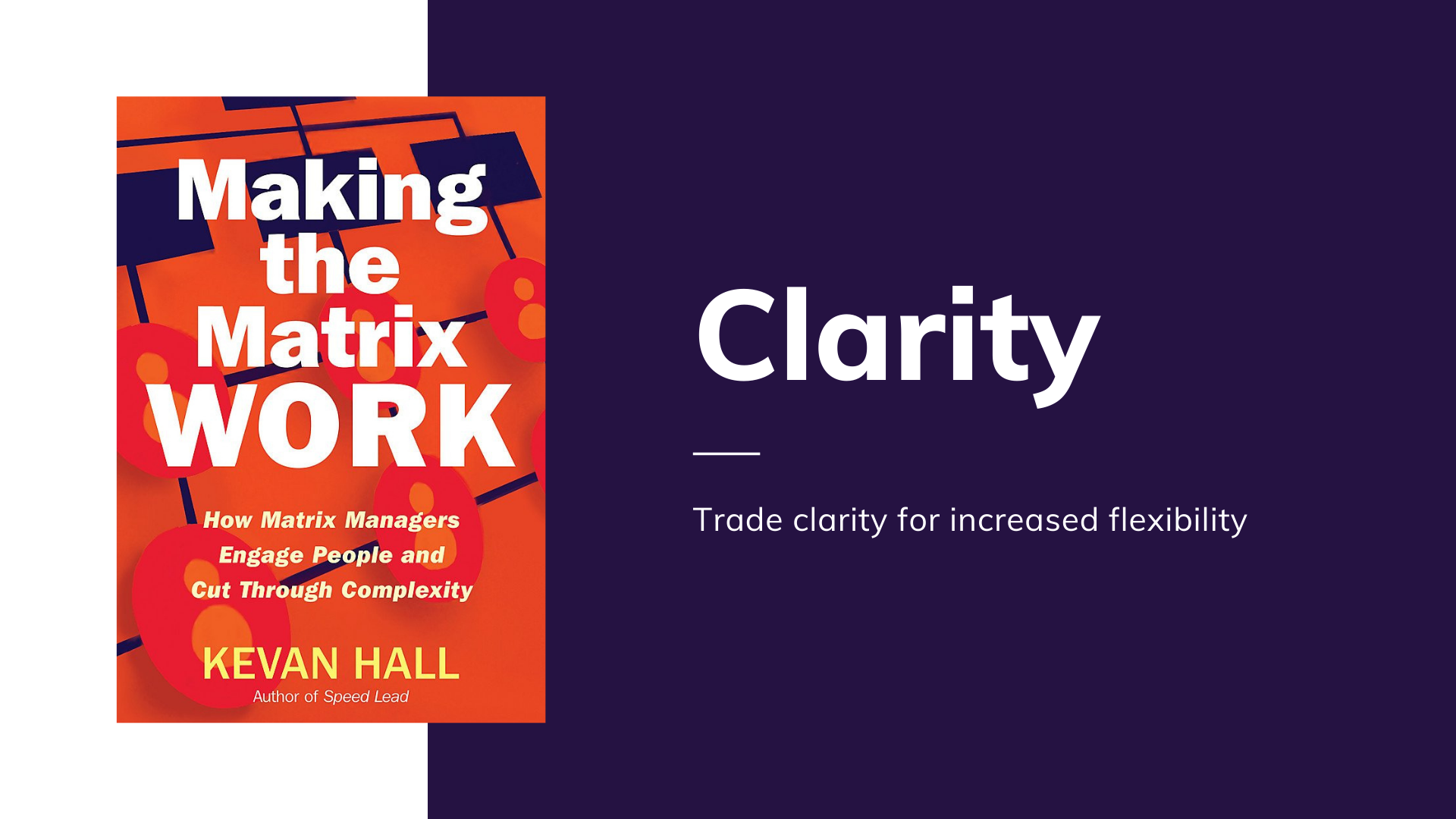
Making the Matrix WORK – Clarity

“How can I be accountable for something I don’t control?”
“How can I get things done without authority?”

Welcome to the matrix, where multiple bosses, competing goals, influence without authority, and accountability without control are the norm. It is a world where skills, not structure, are the drivers of business and personal success.

Continue reading

Atomic Habits

atomic habits

What is a habit? How can one recognize a habit?

Let’s start with a fun example

A kindergarten teacher that has worked with kids for the last 20 years of her life and today she works in a corporate office. Observing her in the corporate office, people identified that when she hears the sound of somebody exiting the bathroom she is naturally asking out loud the following question “Have you washed your hands?”

Is the sound of somebody exiting the bathroom a trigger that is causing her to ask the question about washing hands?
Is her asking this question an automatism that she has built in the last 20 years working as a kindergarten teacher?

The next example is more academic

Continue reading

Debugging Angular 2

debug angular 2

In my opinion Angular 2 is a great framework to work with. But as a developer, you know that you will also need great debug features in order to have a good experience developing.

There are multiple IDEs you can use to develop in Angular 2, but for this article I will talk about Visual Studio Code – VSCode. It has great typescript support and the auto-suggest knows about the angular 2 components.

Typescript is good when developing, the learning curve is smooth, but be aware that browsers don’t know how to run .ts files. This is why you will have to “transpile” your code. Transpiling is the process of converting your code from typescript to javascript(es6).

Continue reading

Android: offline capabilities using Firebase


Firebase apps work offline and enabling disk persistence allows your app to keep all of its state even after an app restart. Firebase also provides several tools for monitoring presence and connectivity state, as we will cover in the lines bellow.

First of all, in order to be able to use Firebase on Android we need to:

Continue reading